
Contents
Every management development programme teaches you how to manage your team. Very few teach you how to lead upwards.
And yet, a manager's ability to influence their own boss — to shape decisions, surface disagreement productively, and build a relationship that improves both information flow and outcomes — is one of the strongest predictors of their long-term effectiveness.
This is not about flattery. It is not about office politics. It is a discipline, and it can be learned.
This article draws on research in leadership psychology, organizational behavior, and influence theory to outline what leading upwards actually involves, where most managers go wrong, and what the best ones do differently.
Upward Leadership Is Not Politics
Leading upwards is not flattery. It is not office politics. It is a discipline — a structured set of skills that improve information flow, decision quality, and organizational outcomes. It can be learned, practised, and developed like any other management capability.
In Brief
Leading upwards is a research-backed management discipline — not flattery or politics. It involves diagnosing the systemic pressures your boss operates under, building trust (especially benevolence trust), pre-wiring influence before formal decisions, practising constructive dissent anchored in shared goals, and repairing trust quickly when things go wrong. Managers who develop this capability create better information flow, improve decision quality, and advance their own credibility and career.
Key Takeaways
- Your boss's behavior is often shaped by systemic pressures, not personality — diagnose the system first
- Benevolence trust — the belief that you act in your boss's interest — is the trust dimension most managers under-invest in
- Influence is won before the meeting: pre-wire your proposals in private conversations, not in group settings
- Constructive dissent is a learnable skill: anchor in shared goals, lead with data, offer alternatives, and accept the outcome
- Three silent credibility killers: solving problems your boss didn't know existed, communicating at the wrong altitude, and treating the relationship as transactional
- Trust repair follows a predictable pattern: name the gap quickly, adjust process visibly, and demonstrate consistency over time
- Leading upwards is a weekly discipline, not an innate talent — the best managers practise it deliberately
1. Your Boss Is Not the Problem. The System Is.
The most common mistake managers make when thinking about their boss is to start with personality. "She's a micromanager." "He doesn't listen." "They're politically driven." These labels feel satisfying — and they are almost always incomplete.
Research in organizational behavior, particularly Gabarro and Kotter's foundational work on managing your boss (1980, 2005), reframes this entirely. Your boss is not operating in a vacuum. They are embedded in their own set of pressures: performance expectations from their own superiors, political dynamics they may not have chosen, resource constraints they cannot fully control, and information asymmetries that shape their behavior in ways you may not see.
This means that a significant portion of what feels like a "difficult boss" is actually a systems problem. The manager who micromanages may have been blindsided before. The one who seems disengaged may be managing a crisis two levels above you. The one who blocks your ideas may be under pressure to show short-term results that conflict with your proposal.
This distinction matters because it changes what you do next. If the problem is personality, there is little you can control. If the problem is systemic, there is a great deal you can do — starting with better diagnosis.
The Diagnostic Before the Judgement
Before forming a view about your boss, ask three questions:
1. What pressures are they under that I don't fully see?
Identify the political, financial, and performance demands shaping their decisions.
2. What information do they have — or lack — that explains this decision?
Consider the information asymmetry between your level and theirs.
3. What patterns in my own behavior might be contributing to the dynamic?
Honest self-diagnosis before labelling your boss.
This is not about excusing poor leadership. It is about moving from frustration to diagnosis — and from diagnosis to action.
2. The Trust Equation You're Probably Getting Wrong
Trust between a manager and their boss is not one thing. Research identifies at least three distinct forms (Mayer, Davis & Schoorman, 1995):
Competence Trust
"I trust that you can do the job." Most managers invest heavily here — and they should. But competence trust alone is not enough.
Integrity Trust
"I trust that you'll do what you say." This is about consistency, honesty, and follow-through. It's table stakes for any working relationship.
Benevolence Trust ★
"I trust that you have my interests in mind — not just your own." This is the dimension that most managers under-invest in. And it is the one that unlocks everything else.
Why does benevolence trust matter so much? Because it changes how your boss interprets everything you do. When benevolence trust is high, disagreement feels like partnership. When it is low, the same disagreement feels like insubordination. When benevolence trust is high, your boss gives you the benefit of the doubt. When it is low, every misstep is scrutinised.
This aligns with leader–member exchange (LMX) theory (Graen & Uhl-Bien, 1995), which shows that the quality of the relationship between a leader and a direct report has a measurable impact on performance ratings, access to information, autonomy, and career outcomes. But the theory applies in both directions: the quality of the relationship you build upward shapes what you can achieve.
What Benevolence Trust Looks Like in Practice
Benevolence trust is built not by flattery but by demonstrating that you take your boss's context seriously. This means:
- •Flagging emerging risks early, rather than waiting until they become problems your boss has to escalate
- •Framing proposals in terms of their priorities, not just your own
- •Closing information gaps proactively: if you know something relevant to their decision-making, surface it without being asked
- •Acknowledging trade-offs honestly, rather than overselling or under-disclosing
In practice, the managers who are most effective at leading upwards are those whose bosses feel protected by them — not from challenge, but from surprises.
3. The Influence Gap: Why Your Best Ideas Die in the Room
Many managers assume that influence is about having the best argument in the meeting. It is not. Dutton and Ashford's research on issue selling (1993, 2001) shows that the most effective upward influencers do their work before the formal conversation.
The reason is structural. In most organizations, your boss is making decisions under uncertainty, with limited time, and with multiple competing inputs. By the time a decision reaches a formal meeting, positions are already forming. The manager who walks in with a proposal that their boss has never heard before — no matter how strong — is fighting against the gravitational pull of whatever the boss has already been thinking.
The Influence Gap
The most effective upward influencers do their work before the formal conversation. In most organizations, by the time a decision reaches a formal meeting, positions are already forming. Walking in with a proposal your boss has never heard before means fighting against the gravitational pull of what they've already been thinking.
The Pre-Wire: Influence Before the Room
Effective upward influence follows a pattern, often called "pre-wiring":
Have the conversation with your boss before the meeting
Not to lobby, but to share your thinking, ask for their reaction, and understand their concerns.
Surface objections privately
Allow your boss to raise doubts without an audience — this is where their real thinking emerges.
Adjust the proposal if needed — turn your boss into an advocate
By the time the proposal reaches the formal setting, your boss is not hearing it for the first time — they helped shape it.
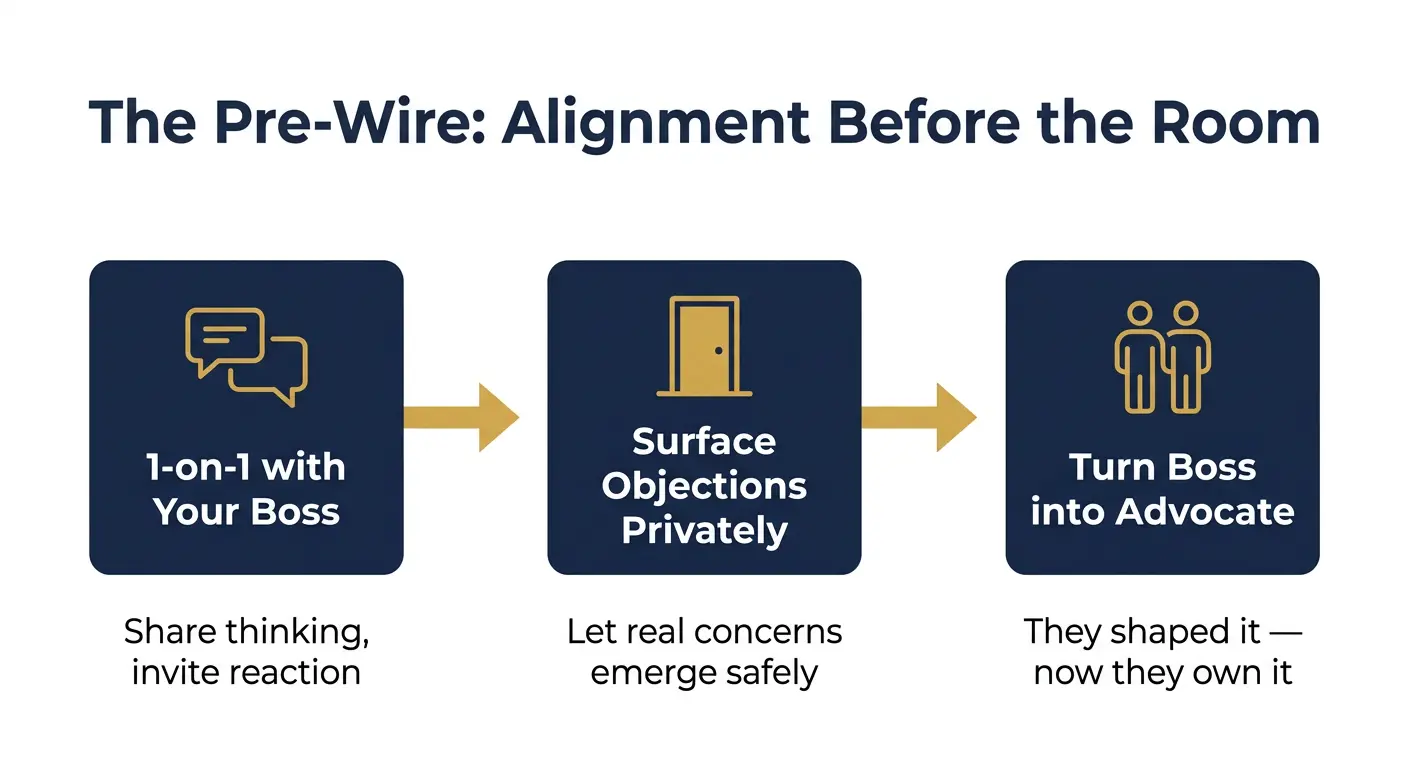
This is not about being manipulative. It is about understanding how decisions actually get made — and working with that process, not against it.
Scenario: The Budget Proposal
Imagine you need budget approval for a new team capability. Rather than preparing a polished deck for the quarterly review, you:
- 1.Raise the idea informally in a 1:1 — “I’ve been thinking about X. Here’s why it matters. What’s your initial reaction?”
- 2.Learn that your boss is under pressure to reduce headcount — something you didn’t know
- 3.Adjust your proposal to show how the capability could be built within existing headcount through reallocation
- 4.Present the adjusted version at the formal meeting — with your boss already aligned
The outcome is not guaranteed. But the probability of success — and the preservation of the relationship either way — is dramatically higher.
4. Strategic Disagreement: The Skill Nobody Teaches
One of the most valuable — and most difficult — aspects of leading upwards is knowing how and when to disagree with your boss.
Research on psychological safety (Edmondson, 1999) shows that the ability to speak up without fear of punishment is a key predictor of team performance. But this concept is usually discussed from the leader's perspective: how leaders can create safety for their team.
What is far less discussed is the reverse: how managers can disagree upwards in a way that is heard, that preserves trust, and that actually improves outcomes.
The reality is that most bosses want honest input — but not all forms of disagreement land well. The difference between a career-building moment and a career-limiting one often comes down to framing, timing, and delivery.
A Framework for Constructive Dissent
The managers who do this well become the most trusted voices in the room — precisely because they push back with care and preparation, not impulse.
5. The Three Mistakes That Silently Destroy Your Upward Credibility
These are not obvious failures. They are patterns that slowly erode trust and influence — often without the manager realising it.
Mistake 1: Solving Problems Your Boss Didn't Know Existed
You see a problem, you fix it, you tell your boss afterwards. You expect credit. Instead, your boss feels blindsided — "Why didn't I know about this?"
Better approach:
- → Flag the issue early
- → Propose your solution
- → Solve it in parallel
The sequence is: signal, propose, solve — not solve, then signal.
Mistake 2: Communicating at the Wrong Altitude
Some bosses want the headline. Others want the detail. Knowing the difference — and adapting — is one of the simplest and most impactful upward leadership skills.
Better approach:
- → Ask directly: "Would you like the summary or the detail?"
- → Lead with the headline, then offer to go deeper
- → Read the room and adjust in real time
Managers who communicate at the right altitude consistently get more airtime, more trust, and more influence.
Mistake 3: Treating the Relationship as Transactional
The manager who only goes to their boss when they need something — approval, resources, air cover — trains the boss to see every interaction as a request. Over time, the relationship becomes transactional, and influence shrinks.
Better approach:
- → Invest in the relationship when you don't need anything
- → Share relevant information proactively
- → Acknowledge good decisions or support when it happens
- → Create a rhythm of contact that is not purely task-driven
6. Recovery: What Separates Good Managers from Great Ones
Even with the best intentions, things go wrong. You miss a commitment. You blindside your boss. You misjudge a political situation. What happens next is what separates good managers from great ones.
Research on trust repair (Kim et al., 2004; Dirks et al., 2009) shows that recovery is not primarily about the apology — it is about visible process change. Your boss is not looking for contrition. They are looking for evidence that the same mistake won't happen again.
The Three Most Common Breaks — and How to Repair Them
Break: Missed Commitment
You promised a deliverable and didn't meet it. It could be a deadline, a quality standard, or a result.
Recovery path:
- 1. Name it quickly — don't wait for your boss to discover it
- 2. State the cause without excusing it
- 3. Show the adjusted plan — "Here's what I've changed to make sure this doesn't happen again"
- 4. Follow through visibly on the adjusted plan
Leading Upwards Is a Discipline, Not an Instinct
The managers who lead upwards well are not necessarily more charismatic, more political, or more senior. They are more deliberate. They invest in understanding the system their boss operates in. They build trust — especially benevolence trust — before they need it. They pre-wire their influence. They disagree constructively. And when they make mistakes, they repair quickly and visibly.
This is not a personality trait. It is a set of learnable, practicable skills.
And the organizations that build this capability into their management development — not as a module on "managing up," but as a core discipline of leadership — will see better information flow, better decisions, and stronger performance at every level.
Weekly Upward Leadership Practice
Ten concrete actions drawn from this article. Check them off each week to build the habit.
Key References
- Gabarro, J. J., & Kotter, J. P. (1980, 2005). Managing Your Boss. Harvard Business Review.
- Mayer, R. C., Davis, J. H., & Schoorman, F. D. (1995). An Integrative Model of Organizational Trust. Academy of Management Review, 20(3), 709–734.
- Graen, G. B., & Uhl-Bien, M. (1995). Relationship-Based Approach to Leadership: Development of Leader-Member Exchange (LMX) Theory. Leadership Quarterly, 6(2), 219–247.
- Dutton, J. E., & Ashford, S. J. (1993). Selling Issues to Top Management. Academy of Management Review, 18(3), 397–428.
- Dutton, J. E., Ashford, S. J., O'Neill, R. M., & Lawrence, K. A. (2001). Moves That Matter: Issue Selling and Organizational Change. Academy of Management Journal, 44(4), 716–736.
- Edmondson, A. C. (1999). Psychological Safety and Learning Behavior in Work Teams. Administrative Science Quarterly, 44(2), 350–383.
- Kim, P. H., Ferrin, D. L., Cooper, C. D., & Dirks, K. T. (2004). Removing the Shadow of Suspicion: The Effects of Apology Versus Denial for Repairing Competence- versus Integrity-Based Trust Violations. Journal of Applied Psychology, 89(1), 104–118.
- Dirks, K. T., Kim, P. H., Ferrin, D. L., & Cooper, C. D. (2011). Understanding the Effects of Substantive Responses on Trust Following a Transgression. Organizational Behavior and Human Decision Processes, 114(2), 87–103.
Develop upward leadership as a core management capability
Leading upwards is a learnable discipline. When organizations embed it into management development, they unlock better information flow, better decisions, and stronger performance at every level. Progressica works with leadership teams to build this capability systematically.
Written by

Founder & Principal Consultant
MSc in I/O Psychology, 13+ years in leadership roles with A.P. Moller Group, now advising global organizations on talent strategy.
Progressica is a certified Predictive Index partner providing talent optimization services across Europe. We help organizations align people strategy with business strategy using validated behavioral and cognitive science. Learn more about us.