Contents
Every organization makes people decisions — who to hire, how to develop talent, where to invest in leadership, and how to build effective teams. Yet the quality of those decisions varies enormously. Too often, organizations rely on intuition, unstructured interviews, or surface-level credentials. Talent assessments offer a more reliable, evidence-based alternative.
A talent assessment is a scientifically developed tool designed to measure specific attributes — such as behavioral tendencies, cognitive ability, or job-specific requirements — that predict how someone is likely to perform in a given role or context. When used responsibly, talent assessments help organizations reduce bias, improve decision quality, and align their people strategy with business outcomes.
This guide explores what talent assessments are, what they measure, why scientific rigor matters, and how they can be implemented across hiring, development, team building, and strategic workforce planning — with particular reference to the Predictive Index (PI) system and the concept of talent optimization.
In Brief
Talent assessments are scientifically validated tools that measure behavioral drives, cognitive ability, and job-specific requirements to support better people decisions across hiring, development, and team building. When grounded in validated science — such as assessments certified by EFPA or aligned with APA and SIOP standards — they reduce bias, improve prediction of job performance, and provide a shared language for coaching. This guide covers what assessments measure, how to implement them responsibly, and how they fit into a broader talent optimization strategy.
Key Takeaways
- Talent assessments measure behavioral drives, cognitive ability, and job-fit requirements — each serving distinct purposes in the employee lifecycle.
- Scientific validation (reliability, validity, and fairness) is non-negotiable for assessments used in hiring and development decisions.
- The PI Behavioral Assessment captures four core drives (Dominance, Extraversion, Patience, Formality) across three behavioral patterns: Self, Self-Concept, and Synthesis.
- Assessments reduce bias and improve quality of hire when integrated into structured hiring workflows with Job Targets.
- Coaching becomes more effective when grounded in shared behavioral data — managers can adapt their style to individual drives.
- Team-level assessment data reveals behavioral gaps, communication risks, and strategic misalignments before they become problems.
- Talent optimization connects individual assessment data to team design, strategy execution, and organizational-level outcomes.
What Talent Assessments Measure
Not all assessments measure the same thing, and understanding these distinctions is essential for choosing the right tool. There are three primary types of talent assessments, each designed to answer a different question.
Behavioral Assessment
Measures: Workplace behavioral drives — how someone naturally works, communicates, and makes decisions.
Example: The PI Behavioral Assessment™ measures four core drives: Dominance, Extraversion, Patience, and Formality.
Used for: Hiring, coaching, team composition, development.
Cognitive Assessment
Measures: General cognitive ability — how quickly someone can learn, adapt, and process complex information.
Example: The PI Cognitive Assessment™ is a timed, 12-minute evaluation of verbal, numerical, and abstract reasoning.
Used for: Predicting trainability and role complexity fit.
Job Assessment
Measures: The behavioral and cognitive requirements of a specific role — what success looks like before any candidate is evaluated.
Example: The PI Job Assessment™ produces a Job Target that defines the ideal behavioral and cognitive profile for a role.
Used for: Role design, structured hiring, candidate-role fit.
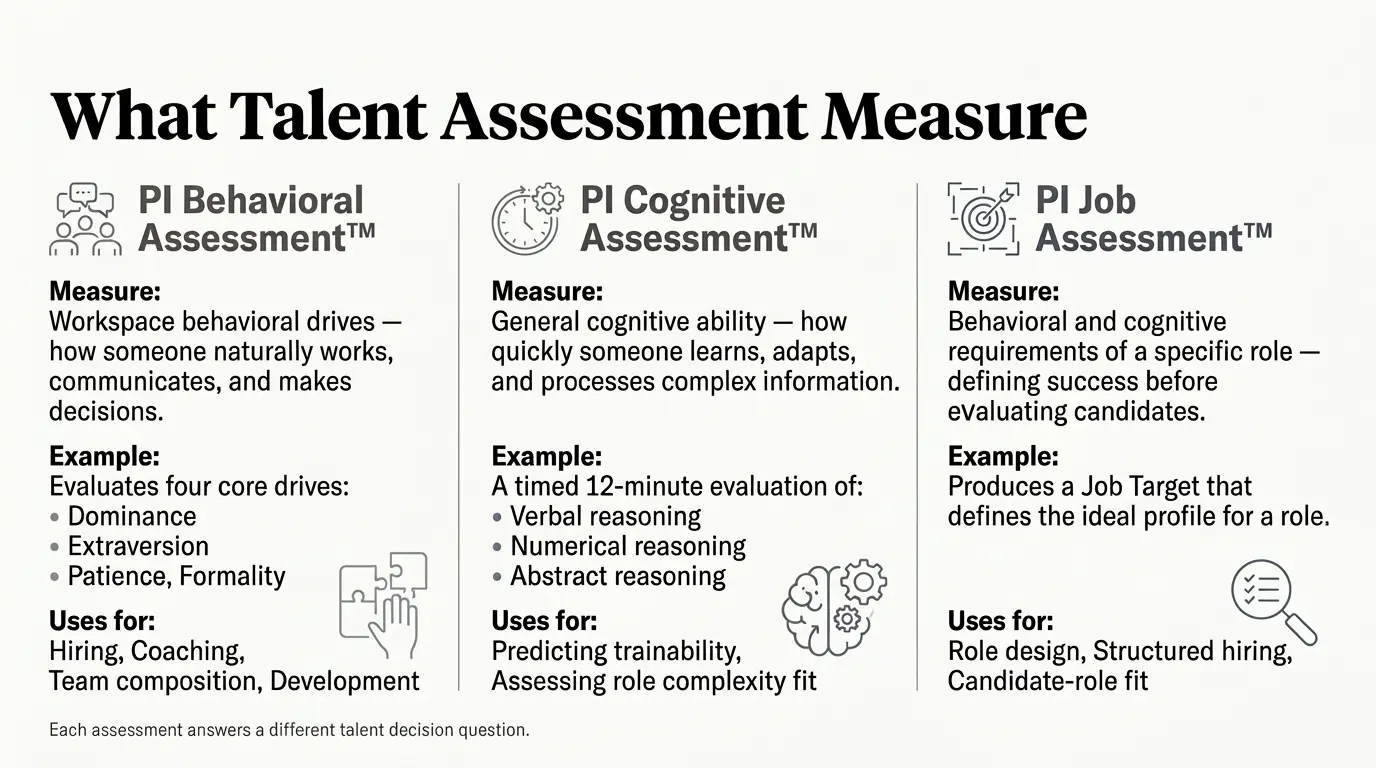
Together, these three types provide a comprehensive picture of who someone is (behavioral drives), how quickly they can learn (cognitive ability), and what the role demands (job requirements). The most effective organizations use all three in combination — not as standalone scores, but as integrated inputs for better decisions.
Understanding Self, Self-Concept, and Synthesis
The PI Behavioral Assessment produces three distinct behavioral patterns, each capturing a different aspect of workplace behavior:
Self
Your natural, instinctive behavioral drives — how you behave when you feel free to be yourself. This is your "default mode."
Self-Concept
How you believe you should behave in your current role or environment — the conscious adjustments you make based on perceived expectations.
Synthesis
The combination of Self and Self-Concept — how you actually show up at work day to day. This is the observable pattern.
The Self-to-Self-Concept Gap: When the Self-Concept diverges significantly from the Self, it indicates that someone is consciously adapting their behavior — stretching into areas that are not natural for them. A small gap is normal; a large, sustained gap may signal stress, role misfit, or a need for coaching. Recognising this gap is one of the most powerful applications of the PI Behavioral Assessment in coaching and management.
Why Scientific Validation, Reliability, and Fairness Matter
An assessment is only as useful as the science behind it. Three properties are essential:
Validity
Does the tool actually measure what it claims to measure? Predictive validity — the ability to forecast job performance — is especially important in hiring contexts. Construct validity confirms that the underlying theory is sound.
Reliability
Does the tool produce consistent results over time and across populations? High test-retest reliability means someone's results remain stable, reinforcing confidence in the data.
Fairness
Does the tool perform consistently across demographic groups (gender, ethnicity, age)? Fairness testing ensures that assessments don't systematically disadvantage any group — a requirement for ethical and legally defensible use.
Standards & Certifications
APA + SIOP Standards
The American Psychological Association (APA) and the Society for Industrial and Organizational Psychology (SIOP) jointly publish the Standards for Educational and Psychological Testing — the primary reference for assessment quality. Well-designed assessments are designed to align with these standards across validity, reliability, and fairness.
EFPA Framework
The European Federation of Psychologists' Associations (EFPA) operates a Test Review Model used across European countries. This independent, peer-reviewed evaluation examines an assessment's psychometric properties, documentation, and user guidance.
PI Certifications
The PI Behavioral Assessment™ received EFPA certification in 2018 and was recertified in 2021, confirming it meets rigorous European psychometric standards for workplace use. The PI Cognitive Assessment™ has also been independently reviewed under the EFPA framework.
Organizations should ask assessment providers for technical manuals, peer-reviewed research, and evidence of third-party review. An assessment without published validity and fairness data should raise a red flag — regardless of how polished its user experience may be.
Benefits of Using Talent Assessments
The value of talent assessments extends across the entire employee lifecycle — from hiring and onboarding to coaching, team design, and succession planning. Organizations that integrate validated assessments into their talent processes consistently report improvements in decision quality, efficiency, and employee outcomes.
Improved quality of hire
Structured assessment data predicts job performance better than unstructured interviews alone.
Reduced mis-hires
Clearer candidate-role fit data reduces costly bad hires and early turnover.
Faster onboarding
Managers use assessment profiles to tailor onboarding and coaching from Day 1.
Better coaching conversations
Shared behavioral language makes feedback more specific, constructive, and actionable.
Stronger team composition
Team-level behavioral data reveals gaps, redundancies, and communication risks.
Data-driven workforce planning
Assessment data supports succession planning, high-potential identification, and strategic staffing.
Talent Assessments in Recruitment
Recruitment is where talent assessments have the most immediate and measurable impact. By introducing objective, validated data into the hiring process, organizations can move beyond gut feel and surface-level CV screening.
The starting point is a Job Assessment — a structured process that defines what success looks like in a role before any candidates are evaluated. In the PI system, this produces a Job Target: a data-backed profile specifying the behavioral and cognitive attributes most associated with success in that role.
Candidates then complete the PI Behavioral Assessment and, where relevant, the PI Cognitive Assessment. Their results are compared to the Job Target to identify alignment and areas of potential stretch. This data feeds into structured interview guides generated by PI Hire, helping interviewers ask better questions and evaluate candidates more consistently.
The result: data-driven hiring that is faster, fairer, and more predictive of on-the-job success.
Talent Assessments for Coaching and Employee Development
Beyond hiring, talent assessments are a catalyst for more effective coaching and development. When managers understand an employee's behavioral profile — their natural drives, communication preferences, and areas of potential stretch — they can tailor their approach rather than relying on one-size-fits-all management.
In the PI system, PI Inspire translates assessment data into actionable coaching insights. Managers access Relationship Guides that compare their own behavioral profile with a direct report's, highlighting likely strengths, friction points, and practical coaching tips. This shared language makes 1:1s more productive and reduces the risk of misunderstanding.
The Self-Concept pattern is particularly relevant here. A significant gap between Self and Self-Concept suggests an individual is adapting their behavior to meet perceived role demands. If sustained, this can lead to stress and disengagement. Coaches and managers who understand this dynamic can intervene early — adjusting role expectations, redistributing responsibilities, or simply having a more informed conversation.
Talent assessments also support structured development programmes, including leadership pipeline design and specialist development. By understanding the behavioral profile of high performers at each career stage, organizations can design more targeted, evidence-based development interventions.
Talent Assessments and Team Dynamics
Individual assessments become even more powerful when aggregated at the team level. Understanding how different behavioral profiles interact — where they complement each other and where they create friction — is essential for building high-performing teams.
PI Design maps a team's collective behavioral profile against the strategic demands of their work. It identifies whether the team has the right balance of drives to execute on its strategy — for example, whether a team tasked with rapid innovation has enough risk-tolerance and proactive energy, or whether a team managing regulatory compliance has sufficient attention to detail and process discipline.
This team-level view helps leaders make better decisions about team composition, communication norms, and role allocation. It also provides a framework for diagnosing team dysfunction — is the team struggling because of a behavioral gap, a strategic misalignment, or a breakdown in interpersonal dynamics?
The Talent Optimization Perspective
Talent optimization is the discipline of aligning people strategy with business strategy using people data. It treats talent assessments not as isolated tools, but as part of a continuous cycle of designing high-performing teams, hiring the right people, inspiring employees to do their best work, and diagnosing engagement and culture challenges.
In this framework, assessments are the foundation — they generate the people data that informs every subsequent decision. The PI platform supports this through four connected modules: PI Hire for recruitment, PI Inspire for management and coaching, PI Design for team strategy, and PI Diagnose for engagement diagnostics.
The strategic value of talent optimization lies in its ability to connect individual and team data to business outcomes — not just to make "better hires," but to systematically build the workforce capability required to execute on the organization's strategy.
Why Organizations Need More Than One Assessment Type
No single assessment can capture everything relevant to a talent decision. Behavioral assessments reveal how someone works; cognitive assessments reveal how fast they can learn; job assessments reveal what the role demands. Each dimension adds predictive power.
In hiring, combining a behavioral assessment with a cognitive assessment and comparing both to a Job Target consistently outperforms any single data point. In development, understanding both drives and learning capacity helps managers set realistic expectations and design more effective growth plans.
At the team level, combining behavioral data with strategic context (via PI Design) creates a far richer picture than behavioral data alone.
The most effective talent strategies use multiple, validated assessment types in combination — not as a checkbox exercise, but as an integrated system for making better people decisions across the lifecycle.
Getting Started: A Practical Implementation Roadmap
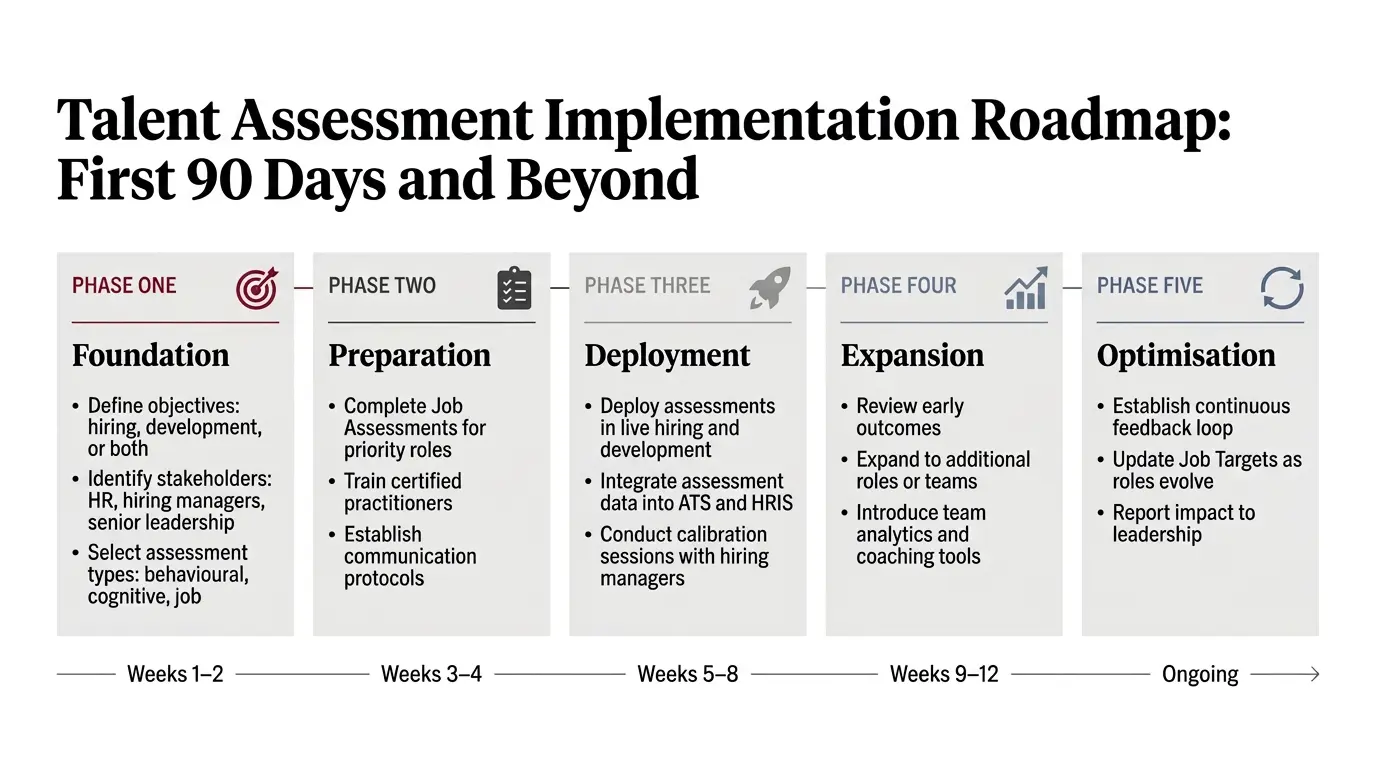
Implementing talent assessments is not a one-day initiative — it's a structured rollout that builds capability over time. Here is a phased approach:
- Define objectives: Why are we using assessments? (Hiring, development, both?)
- Identify stakeholders: HR, hiring managers, senior leadership.
- Select assessment types that match your objectives (behavioral, cognitive, job).
- Complete Job Assessments for priority roles to establish Job Targets.
- Train certified practitioners who will administer and interpret assessments.
- Establish communication protocols: explain purpose and process to participants.
- Deploy assessments in live hiring and/or development contexts.
- Integrate assessment data into existing HR workflows (ATS, HRIS).
- Conduct initial calibration sessions with hiring managers.
- Review early outcomes: quality of hire metrics, manager feedback, candidate experience.
- Expand to additional roles, teams, or use cases.
- Introduce team-level analytics (PI Design) and coaching tools (PI Inspire).
- Establish a continuous feedback loop: measure, refine, and improve.
- Update Job Targets as roles evolve.
- Report impact to leadership: time-to-fill, retention, performance correlation.
Checklist: Your Assessment Implementation Scorecard
Use this interactive checklist to evaluate your organization's assessment maturity. Each item is grounded in the practices described throughout this guide.
Next best action: Start with objectives + role benchmarks.
Common Mistakes When Using Talent Assessments
Even well-intentioned assessment programmes can fall short if certain pitfalls are not avoided:
Using unvalidated or 'pop psychology' assessments
Better approach: Choose assessments with published technical manuals, peer-reviewed evidence, and EFPA/APA/SIOP alignment.
Deploying assessments without training
Better approach: Certify practitioners to interpret results accurately and use them in context — not as labels.
Relying on a single assessment score to make a hire/no-hire decision
Better approach: Use assessments as one input alongside structured interviews, references, and work samples.
Treating results as permanent and fixed
Better approach: Self-Concept changes with role and context; revisit assessments periodically, especially after role transitions.
Failing to communicate purpose to participants
Better approach: Be transparent about why assessments are used and how results will be shared and applied.
Ignoring team-level data
Better approach: Aggregate individual profiles to diagnose team dynamics, gaps, and strategic misalignment.
Conclusion
Talent assessments are not a one-time screening tool — they are a continuous strategic resource that supports better decisions across the entire employee lifecycle. From defining what a role demands, to identifying the right hire, to coaching a new employee through their first months, to designing a team that can execute on strategy — validated assessments provide the data foundation for each of these critical moments.
The key is to treat them as part of a broader talent optimization system: integrated, evidence-based, and continuously refined. When done well, they don't just improve hiring metrics — they elevate the quality of leadership, strengthen team performance, and align people strategy with organizational ambition.
Start with clear objectives. Choose validated tools. Train your people. Measure your outcomes. And never stop refining.
About the Author

Founder & Principal Consultant
MSc in I/O Psychology, 13+ years in leadership roles with A.P. Moller Group, now advising global organizations on talent strategy.
How Progressica Can Help
- Assessment deployment & practitioner certification: Full rollout of PI Behavioral, Cognitive, and Job Assessments with certified training for your internal team.
- Structured hiring process design: Job Target creation, PI Hire implementation, and interview guide training.
- Coaching & development programmes: Using PI Inspire to build behavioral awareness across management layers.
- Team alignment & strategy workshops: PI Design sessions to align team behavioral composition with strategic objectives.
- Ongoing advisory & benchmarking: Quarterly reviews, Job Target updates, and impact reporting aligned with business KPIs.