Contents
Most hiring processes share a structural flaw. They evaluate candidates before defining what the role actually requires. Job descriptions list tasks and responsibilities. Interview questions vary by interviewer. Candidate comparison defaults to impression and instinct. The process feels rigorous because it involves multiple stages, but the stages are not anchored to a shared definition of success.
The cost of this flaw compounds quietly. A mis-hire in a critical role costs an estimated 50 to 200% of annual salary when you account for lost productivity, recruitment costs, management time, and team disruption. Organizations feel the impact but rarely trace it back to the structural cause: the absence of a behavioral and cognitive benchmark built before any candidate walks through the door.
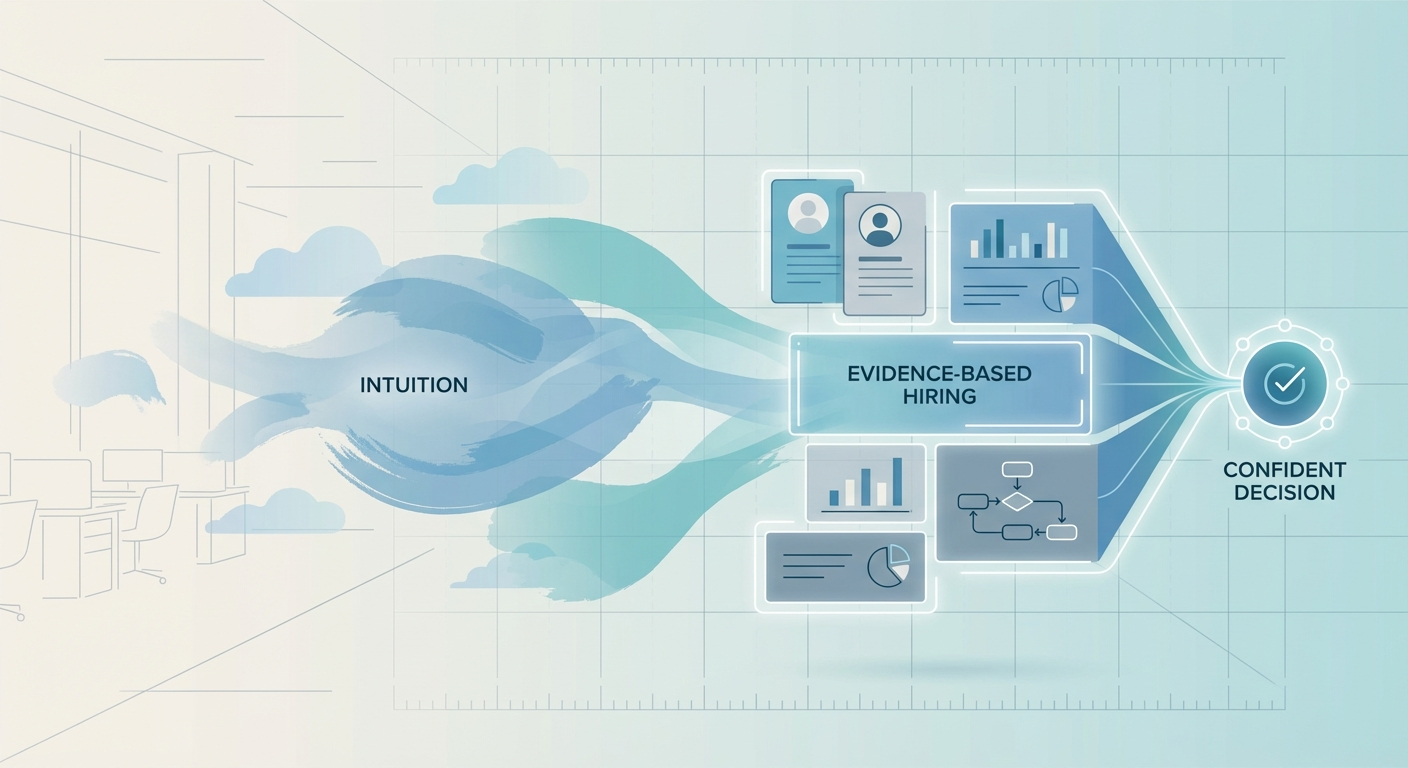
PI Hire addresses this by reversing the sequence. Before any candidate is evaluated, the hiring team defines the behavioral and cognitive profile of the role. Every candidate is then assessed against that benchmark — not against each other, not against impression, and not against whoever presented best in the room. The result is a structured, documented hiring process where comparison is consistent and interview questions are tailored to each candidate's specific areas of divergence from the target.
This article explains how PI Hire works, what each component does, what it takes to implement it properly, and what to realistically expect from it.
In Brief
PI Hire is the hiring module of the PI Talent Optimization Platform. It combines job benchmarking, validated behavioral and cognitive assessments, candidate-to-target fit analysis, and structured interview support into a single workflow. Before any candidate is assessed, a Job Target defines the behavioral drives and cognitive ability most associated with success in the role. Candidates complete the PI Behavioral Assessment™ (approximately six minutes, untimed) and the PI Cognitive Assessment™ (12 minutes, timed). The platform produces a match score per candidate, highlights areas of alignment and divergence, and generates candidate-specific interview questions. Effective implementation requires training: Decode Workplace Behaviour (full day, mandatory) followed by Predict Candidate Success (half day, mandatory for PI Hire users).
Key Takeaways
- PI Hire is the hiring module of the PI Talent Optimization Platform, one of four modules alongside PI Inspire, PI Design, and PI Diagnose.
- The Job Target is built before any candidate is assessed. It is the most consequential step in the process: a poorly built Job Target produces misleading candidate comparisons regardless of assessment quality.
- The PI Behavioral Assessment takes approximately six minutes to complete, is untimed, and has no right or wrong answers. It measures four core behavioral drives.
- The PI Cognitive Assessment takes 12 minutes, is timed, and measures general cognitive ability across verbal, numerical, and abstract reasoning.
- The Fit Analysis produces a match score of 1 to 10 per candidate against the Job Target, plus a separate cognitive alignment score. A high match score is not a hire recommendation; a low score is not a rejection.
- The Interview Builder generates candidate-specific behavioral and situational interview questions based on each candidate's divergence from the Job Target, with scoring rubrics for interviewer consistency.
- Training is mandatory: Decode Workplace Behaviour (full day) then Predict Candidate Success (half day). Strongly recommended for all hiring managers and HR professionals involved in hiring, not just the Key Contact.
- Pricing is headcount-based with unlimited assessments and candidates within the subscription. No per-assessment fees.
What is the Predictive Index?
The Predictive Index is a talent optimization platform founded in 1955 by Arnold Daniels. It is built on two core validated assessments, the PI Behavioral Assessment and the PI Cognitive Assessment, and organized into four modules: PI Hire (hiring and selection), PI Inspire (management and development), PI Design (team optimization), and PI Diagnose (employee engagement).
The platform is used by over 10,000 organizations globally and is available in more than 70 languages. The PI Behavioral Assessment received certification from the European Federation of Psychologists' Associations (EFPA) in 2018, with recertification in 2021 and again in 2023. This certification confirms the assessment meets European standards for test quality, validity documentation, and ethical use.
PI is not a standalone assessment tool. It is an integrated platform where behavioral and cognitive data flows across hiring, development, team composition, and engagement. PI Hire is where most organizations begin because hiring is the most immediately measurable application. The other modules become relevant as the organization's use of behavioral data matures.
For a broader view of how the four modules connect, see the Talent Optimization Platform overview.
What is PI Hire?
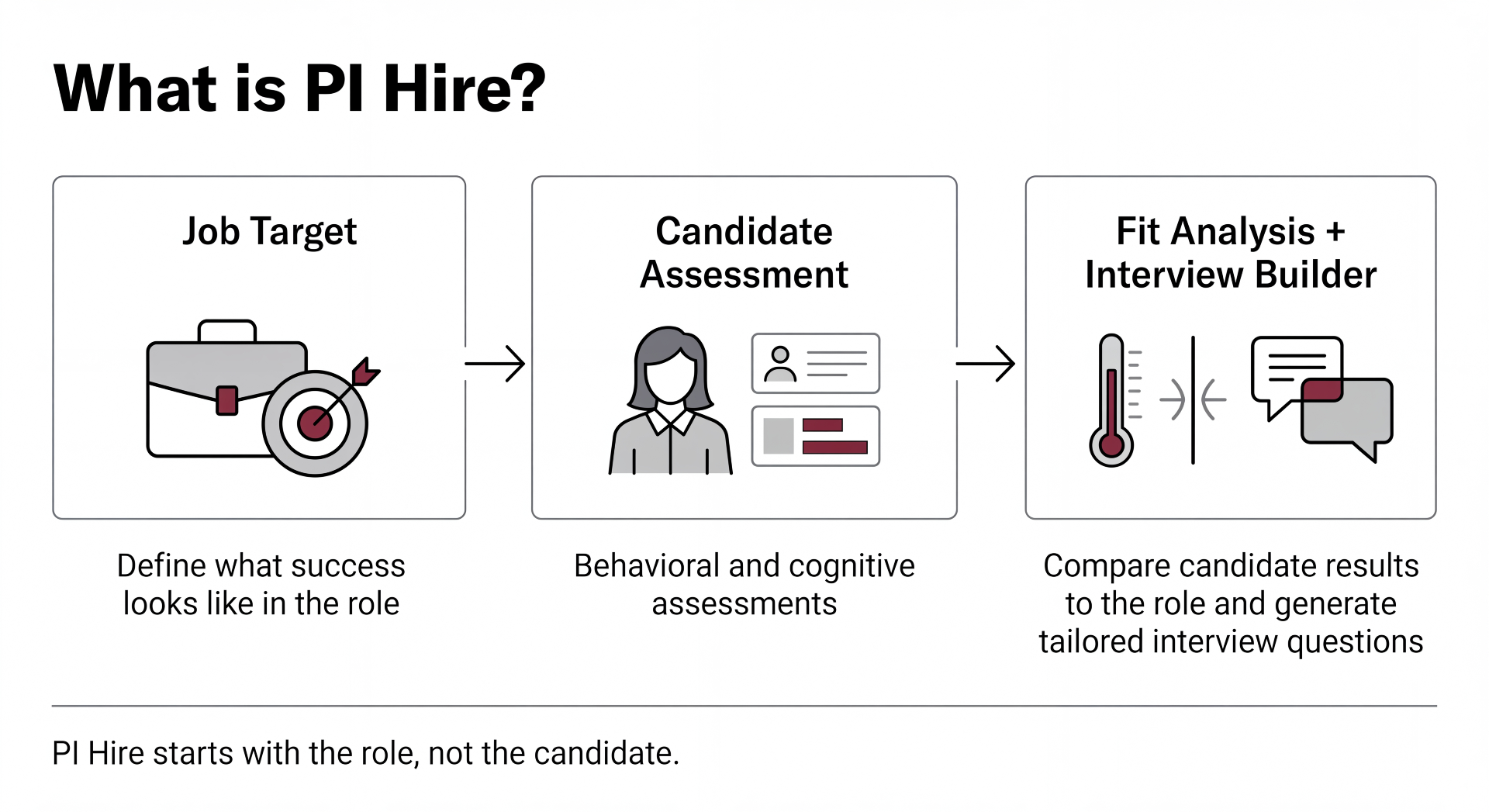
PI Hire is the hiring module of the Predictive Index platform. It combines three capabilities into a single structured workflow: job benchmarking, validated candidate assessment, and data-informed interview support.
The architecture follows a deliberate sequence. First, the hiring team defines what success looks like in the role by building a Job Target. Second, candidates complete the PI Behavioral Assessment and the PI Cognitive Assessment. Third, the platform compares each candidate's results against the Job Target and generates tailored interview questions based on areas of divergence.
This sequence matters. PI Hire does not start with candidates. It starts with the role. That reversal is the structural difference between PI Hire and assessment tools that evaluate candidates in isolation. When every candidate is measured against the same benchmark, comparison becomes consistent rather than impressionistic.
The software does not make hiring decisions. It produces data that informs them. The behavioral and cognitive profiles, match scores, and interview questions are inputs to the hiring team's judgment, not replacements for it. The final decision sits with the people who understand the role, the team, and the organizational context.
PI Hire consists of five core components, each covered in detail in the sections that follow: the Job Target, the PI Behavioral Assessment, the PI Cognitive Assessment, Fit Analysis, and the Interview Builder. Together, they form a complete hiring workflow from role definition through to documented hiring decisions.
Organizations exploring hiring assessment software for the first time will find that PI Hire's job-first approach distinguishes it from tools that focus on candidate profiling without a role benchmark.
The Job Target: the most important step
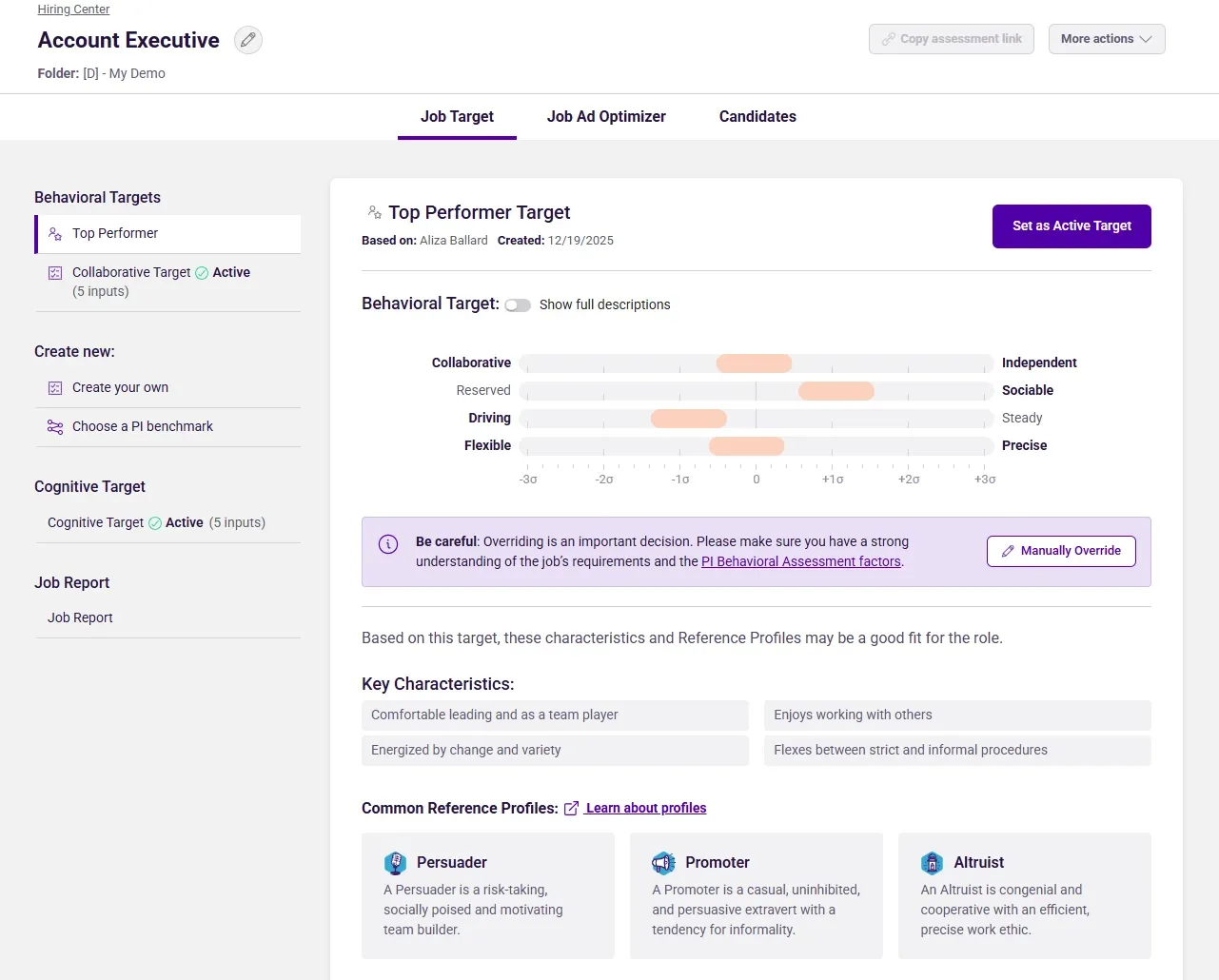
The Job Target is the behavioral and cognitive profile that defines what success looks like in a specific role. It is built before any candidate is assessed. Of all five PI Hire components, this one has the most direct impact on hiring quality, and it is the one most commonly underestimated.
A Job Target specifies two things: the behavioral drives most associated with effective performance in the role, and the cognitive ability level required. It answers a question that most hiring processes skip entirely: what does this role actually need from the person in it, expressed in measurable terms?
How a Job Target is built
The Job Target is built using the PI Job Assessment™, which takes approximately 15 minutes. The process works best when completed collaboratively by three stakeholders: the hiring manager, the hiring manager's manager, and an HR lead. Each stakeholder completes the Job Assessment independently, and the results are compared.
The collaborative design is intentional. It surfaces disagreements about role requirements before any candidate has been evaluated. A hiring manager may prioritize detail orientation and process compliance. Their manager may want someone who drives change and operates with autonomy. These are not complementary expectations, and discovering the conflict after three rounds of interviews wastes everyone's time.
The Job Assessment asks stakeholders to select behavioral traits and cognitive demands they consider most important for the role. The platform synthesizes these inputs into a composite Job Target with specific behavioral drive levels and a cognitive target range.
Why the Job Target matters more than the assessments
A poorly built Job Target produces misleading candidate comparisons regardless of how valid the assessments are. If the target overweights formality for a role that actually requires adaptability, every candidate comparison is skewed. The assessments are doing their job accurately; the benchmark they are compared against is wrong.
This is why Progressica emphasizes the Job Target in every onboarding conversation and demo. The assessments are scientifically validated. The Job Target depends on human judgment, and human judgment needs structure.
Common mistakes
- •Built by one person alone. A single perspective produces a target that reflects one view of the role, not the full picture. The collaborative process exists to prevent this.
- •Based on the last incumbent's profile rather than what the role requires. If the previous person was a high-dominance, low-patience operator and the role actually needs methodical relationship management, the target will attract the wrong candidates.
- •Cognitive threshold set too high. Not every role requires high cognitive ability. Setting the cognitive target higher than the role demands narrows the candidate pool unnecessarily and does not predict better performance.
- •Rebuilt from scratch each time rather than reused and refined. Job Targets for recurring roles should be saved, reviewed after each hire, and refined based on performance outcomes. Starting over each time discards institutional learning.
For a detailed breakdown of the Job Assessment itself, see the PI Job Assessment guide.
The PI Behavioral Assessment
The PI Behavioral Assessment™ is a free-choice, stimulus-response tool that measures four core behavioral drives: Dominance (the drive to exert influence), Extraversion (the drive for social interaction), Patience (the drive for consistency and stability), and Formality (the drive to conform to rules and structure).
How it works
The assessment presents two lists of adjectives. In the first list, the candidate selects words that describe how others expect them to behave. In the second list, they select words that describe how they believe they actually are. There are no right or wrong answers, no time limit, and no trick questions. The assessment takes approximately six minutes to complete.
What it produces
The behavioral assessment generates three behavioral patterns:
- •Self: The candidate's natural behavioral drives — how they behave when not consciously adapting.
- •Self-Concept: How the candidate believes they need to behave in their current environment.
- •Synthesis: The observable blend of Self and Self-Concept — what you would see day-to-day.
The gap between Self and Self-Concept is diagnostically significant. A large gap indicates sustained behavioral adaptation, meaning the person is consistently behaving in ways that differ from their natural tendencies. This information is relevant for coaching conversations, onboarding planning, and understanding potential sources of workplace stress.
Reference Profiles
The assessment maps results to one of 17 Reference Profiles, named behavioral patterns that provide useful shorthand for communication. However, the Reference Profile is a summary label, not a complete description. The underlying drive data (the specific levels of Dominance, Extraversion, Patience, and Formality) is always more useful than the profile name alone. Using Reference Profiles as labels ("She's a Captain" or "He's a Scholar") without understanding the drives behind them is a common misapplication that training is designed to prevent.
Why the behavioral assessment is shown first
In the demo and sales context, the PI Behavioral Assessment is shown before the cognitive assessment. It is more intuitive, immediately useful across both hiring and development contexts, and less likely to raise compliance or sensitivity concerns in a first conversation. This does not mean it is more important. In live PI Hire usage, candidates complete both assessments.
The PI Behavioral Assessment received EFPA certification in 2018, with recertifications in 2021 and 2023, confirming it meets European standards for psychometric quality, validity evidence, and ethical administration.
For the full assessment breakdown, see the PI Behavioral Assessment guide.
The PI Cognitive Assessment
The PI Cognitive Assessment™ measures general cognitive ability across three domains: verbal reasoning, numerical reasoning, and abstract reasoning. It is the second of the two core assessments in the PI platform.
How it works
The assessment consists of 50 questions with a 12-minute time limit. It produces a score ranging from 100 to 450, mapped to a cognitive band. The time limit is a deliberate design feature: cognitive ability assessments measure processing speed and accuracy under constraint, which predicts how quickly someone can absorb new information and adapt to novel problems.
Why cognitive ability matters
General cognitive ability is one of the strongest single predictors of job performance across roles and industries. It predicts trainability (how quickly someone learns new skills and processes), problem-solving under ambiguity, and the ability to handle increasing complexity. This does not mean higher scores are always better. The right cognitive level depends on the role.
How it is used in PI Hire
The Job Target includes a cognitive target — a range defining the minimum and ideal cognitive score for the role. Candidates' cognitive scores are assessed against this target. A candidate whose score falls within the target range shows cognitive alignment with the role's demands. A score significantly above or below the range does not disqualify them, but it does flag a potential mismatch worth exploring in the interview.
The demo context
The cognitive assessment is introduced after the behavioral assessment in the sales and demo process. It requires more careful handling due to the compliance and sensitivity questions that cognitive testing naturally raises. In live usage, clients assess candidates on both assessments as a standard part of the workflow.
For the full assessment breakdown, see the PI Cognitive Assessment guide.
Fit Analysis
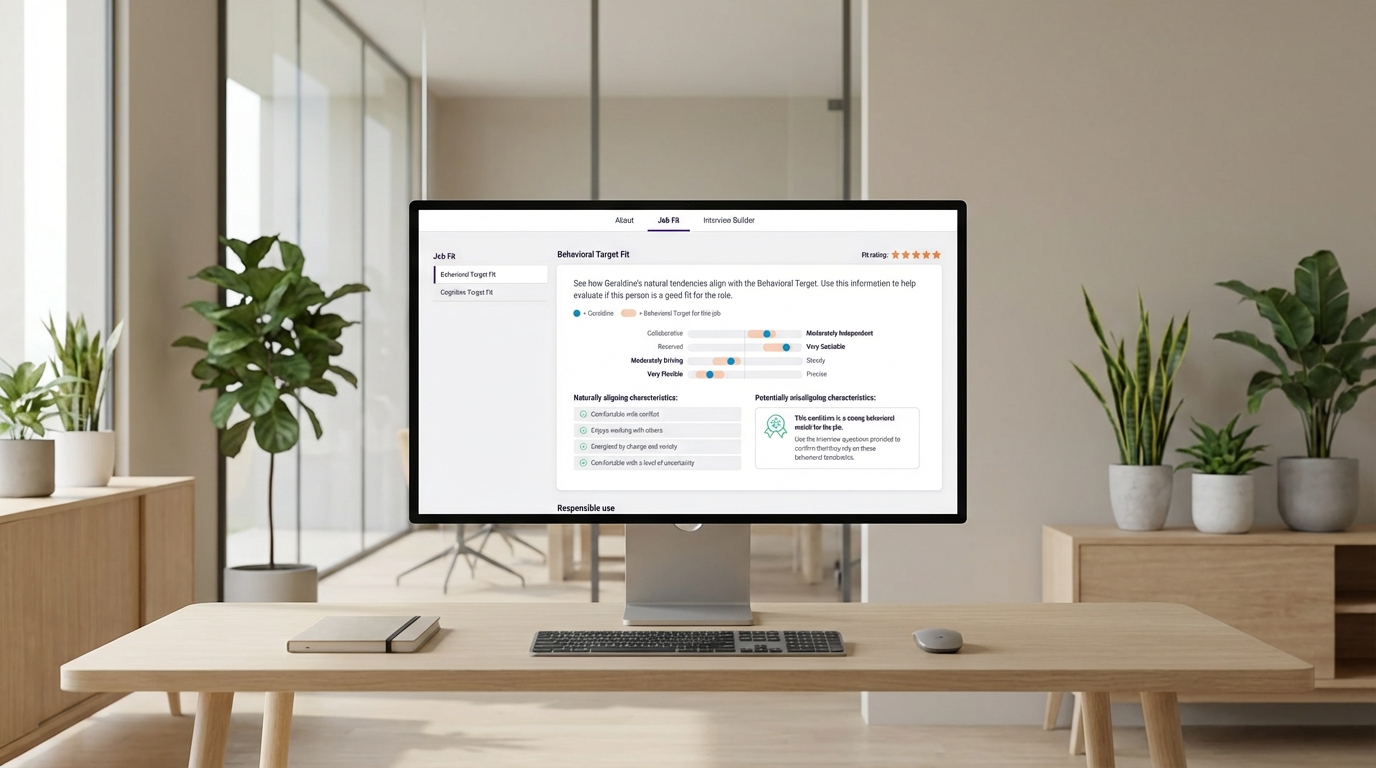
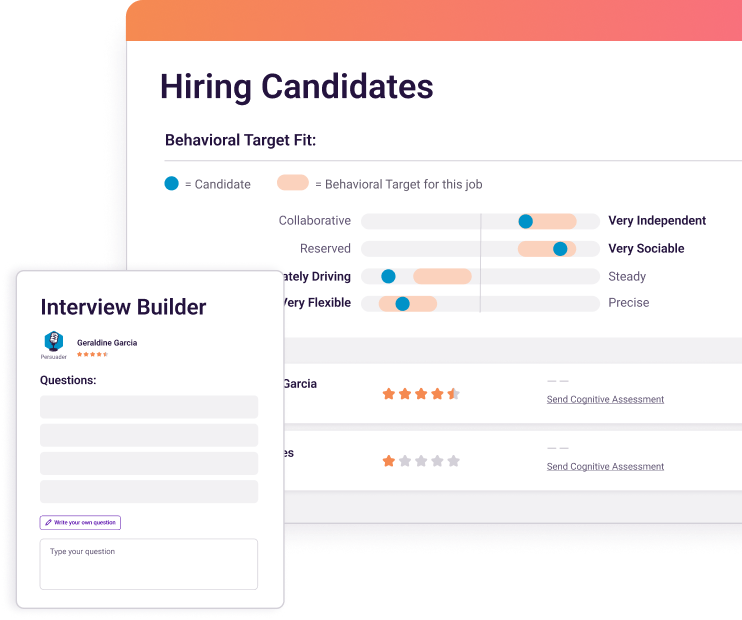
The Fit Analysis is where the Job Target and assessment data converge. For each candidate, PI Hire produces a match score from 1 to 10 against the Job Target, along with a separate cognitive alignment score. The match score reflects how closely the candidate's behavioral profile aligns with the behavioral drives defined in the target.
How to interpret match scores
A high match score does not mean "hire this person." A low match score does not mean "reject this person." The match score is one input in a structured decision, showing where a candidate aligns with the role's behavioral requirements and where they diverge. Divergence is not inherently negative. It is information that should be explored in the interview.
A candidate with a match score of four may be an excellent hire if the areas of divergence are manageable, coachable, or offset by other strengths. A candidate with a match score of nine may still be wrong for the role if the Job Target was poorly constructed or if other factors (experience, motivation, team dynamics) do not align.
Candidate comparison view
PI Hire displays candidates side by side against the Job Target, not against each other. This distinction matters. When candidates are ranked against each other, a weak pool produces a "best available" hire that may still be a poor fit. When candidates are compared against the target, the quality of each candidate is evaluated independently.
The right framing
The Fit Analysis prevents two common hiring errors: weak-pool inflation (choosing the best candidate in a poor pool and mistaking relative ranking for absolute quality) and strong-pool obscuring (overlooking a good candidate because other candidates scored marginally higher on subjective impression). By holding every candidate against the same fixed benchmark, the platform makes pool quality visible rather than hidden.
The Interview Builder
The Interview Builder generates behavioral and situational interview questions tailored to each candidate's specific areas of divergence from the Job Target. It does not produce generic interview templates. The questions are candidate-specific, generated after the assessment results are compared against the target.
Why candidate-specific questions matter
Standard interview processes use the same questions for every candidate. This means areas of potential difficulty are explored unevenly, if they are explored at all. A candidate who scores high on Dominance applying for a role that requires collaborative consensus-building will face different challenges than a candidate who scores low on Formality applying for a role that requires rigorous process adherence. The Interview Builder ensures the questions probe the areas most likely to create difficulty in the role.
Scoring rubrics
Each generated question includes criteria for evaluating the candidate's response. These rubrics improve consistency across interviewers. When three interviewers use the same questions and the same evaluation criteria, the resulting assessments are comparable. When each interviewer asks their own questions and evaluates responses by instinct, comparison is noise.
Structured vs. unstructured interviews
Research consistently shows that structured interviews outperform unstructured interviews in predicting job performance. The challenge is implementation. Most hiring managers do not have the time or training to design structured interview frameworks from scratch. The Interview Builder operationalizes structured interviewing by generating the questions, providing the rubrics, and linking both to the candidate's specific assessment data. The hiring manager's role shifts from question design to response evaluation.
The full PI Hire workflow
The complete PI Hire workflow follows eight steps, from role definition through to a documented hiring decision:
- 1Build the Job Target collaboratively. The hiring manager, their manager, and an HR lead each complete the PI Job Assessment (approximately 15 minutes). The platform synthesizes their inputs into a composite Job Target with behavioral drive levels and a cognitive target.
- 2Post the role. The Job Ad Optimizer suggests language based on the behavioral target, helping align the job posting with the behavioral profile the role requires.
- 3Invite candidates. Candidates receive a single link to complete both the PI Behavioral Assessment and the PI Cognitive Assessment. No scheduling, no proctoring, no separate logins.
- 4Review results against the Job Target. Each candidate's behavioral profile and cognitive score are compared against the target. Match scores, drive-level comparisons, and cognitive alignment are displayed per candidate.
- 5Shortlist based on data. Candidates closest to the target are identified. Divergence areas are flagged for interview exploration rather than used as automatic disqualifiers.
- 6Generate interview guides. The Interview Builder produces candidate-specific behavioral and situational questions with scoring rubrics, tailored to each candidate's areas of divergence from the target.
- 7Conduct structured interviews. Interviewers use the generated questions and rubrics. Responses are evaluated against consistent criteria rather than subjective impression.
- 8Make and document the hiring decision. The hiring team makes the final decision. Assessment data, interview scores, and rationale are documented in the platform. This data remains on file for onboarding conversations and early performance check-ins.
The decision remains with the hiring team at every stage. The platform structures the process, surfaces relevant data, and creates consistency. It does not replace judgment.
What training is required
Training is not optional, and it is not a formality. The quality of a PI Hire implementation depends directly on whether the people using the platform understand what the data means and how to apply it. This section is a practical guide for organizations planning their training investment.
The mandatory foundation: Decode Workplace Behaviour
Decode Workplace Behaviour is a full-day training session. It is mandatory for all PI module users without exception. Nobody skips it. Nobody repeats it. It is completed once and applies across every PI module.
Decode covers what the PI Behavioral Assessment measures, how to interpret the four behavioral drives, how to read Self, Self-Concept, and Synthesis patterns, and how to use behavioral data responsibly. Without this training, users have data they cannot correctly interpret or ethically apply. A behavioral profile without interpretation training is a chart without a legend.
The required module for PI Hire: Predict Candidate Success
Predict Candidate Success is a half-day training session, mandatory for PI Hire users. It is always completed after Decode and can be done in any order relative to other half-day modules.
This session covers building Job Targets effectively, interpreting the Fit Analysis and match scores, using interview guides in practice, and integrating PI Hire into a structured hiring workflow. It is the session that turns platform access into practical capability.
The mandatory sequence
The training sequence is fixed: Decode Workplace Behaviour (full day) → Predict Candidate Success (half day) → PI Hire live usage. There are no shortcuts and no alternative paths.
Who must be trained (minimum)
The Key Contact is the primary administrator and superadmin for the PI platform. At minimum, the Key Contact must complete both Decode and Predict Candidate Success before the organization goes live with PI Hire.
Who should be trained (strongly recommended)
Training the Key Contact alone is the minimum. It is not the recommendation. Progressica strongly recommends training:
- •All line managers with hiring responsibility
- •All HR professionals involved in recruitment or selection
The rationale is practical: a trained Key Contact whose hiring managers have not completed Decode will find that assessment data gets ignored, misread, or overridden at the interview stage. Training the people closest to the hiring decision is what turns PI Hire from a software subscription into a functioning hiring system.
The modular expansion path
As organizations adopt other PI modules, the relevant half-day training module is added. These modules are always completed after Decode, in whatever order fits the organization's priorities:
- •Develop Effective Leaders (for PI Inspire)
- •Build High-Performing Teams (for PI Design)
- •Boost Employee Engagement with PI Diagnose (for PI Diagnose)
The training timing gap
Subscription access begins before training is complete. The platform is available from day one of the subscription, but Decode and Predict Candidate Success may not be scheduled for several weeks. Progressica bridges this gap with an onboarding session that covers platform navigation, sending assessments, and reviewing results.
The Key Contact dependency
If the trained Key Contact leaves the organization before other team members have been trained, adoption stalls. This is the most common and most preventable implementation risk. The mitigation is straightforward: train more than one person.
For scheduling and format details, see the Predictive Index Training page.
Pricing and subscription model
PI Hire uses a headcount-based pricing model, not a usage-based one. The subscription is based on the number of employees in the organization, not on the number of assessments administered or candidates evaluated.
This means there is no cost penalty for using PI Hire across every open role, for assessing internal candidates for promotions, or for running the PI Behavioral Assessment with existing employees for development purposes. The unlimited model removes the per-use friction that causes some organizations to ration assessment usage and apply it inconsistently.
Subscriptions are available in one, two, or three year terms. Longer terms offer better per-year pricing and provide stability for organizations building PI Hire into their standard hiring process.
Training is a separate investment from the platform subscription. The cost covers facilitation of Decode Workplace Behaviour, Predict Candidate Success, and any additional half-day modules the organization adds as it expands to other PI modules.
Specific pricing is not published. Progressica provides a tailored proposal after the demo, based on organization size and subscription term. To request pricing, contact us or book a demo directly.
Who PI Hire is right for
PI Hire is not the right fit for every organization. Honest qualification saves time for both sides.
Works best when
- Hiring managers and HR are willing to build Job Targets collaboratively, investing 15 minutes per role to define what success looks like before evaluating anyone.
- Leadership is open to using behavioral and cognitive data alongside professional judgment, not as a replacement for it.
- The organization hires across multiple roles and wants a consistent, documented process that produces comparable data across every hire.
- A committed Key Contact exists who will champion the platform internally, drive training completion, and ensure behavioral data reaches the people making hiring decisions.
- The organization is willing to train line managers and HR professionals involved in hiring, not just the minimum Key Contact requirement.
- Assessment is seen as relevant beyond external recruitment: internal mobility, promotion decisions, succession planning, and onboarding all benefit from behavioral and cognitive data that already exists in the platform.
Worth considering carefully when
- •The organization is not ready to have structured conversations about what success looks like in a role. If the Job Target process feels burdensome rather than useful, PI Hire's core mechanism will be underutilized.
- •There is no internal champion to drive adoption after training. Without someone who consistently ensures the platform is used for every relevant hire, usage tends to drop off within six months.
- •Leadership expects the software to make hiring decisions rather than inform them. PI Hire produces data. If the expectation is a 'hire/don't hire' recommendation, the platform will disappoint.
- •The organization is unwilling to invest in training beyond the minimum Key Contact requirement.
Getting started: what the process looks like
The path from first contact to live PI Hire usage follows seven steps. Knowing what to expect at each stage makes planning easier.
- 1Discovery call or demo request. Most organizations start with a demo request. For complex situations (multi-country rollouts, large headcounts, integration with existing HR systems), a discovery call may precede the demo to ensure the demo itself is relevant.
- 2Demo. The demo is personalized. Progressica uses one of the organization's real roles to demonstrate the process. The PI Behavioral Assessment is shown live: one of the stakeholders completes it, and the results are reviewed together. The collaborative Job Target process is demonstrated as the centerpiece.
- 3Proposal. Headcount-based pricing with one, two, or three year subscription terms. The proposal includes the platform subscription and the training investment as separate line items.
- 4Subscription start. Platform access begins. The organization can navigate the platform, but formal training has not yet occurred.
- 5Onboarding session. Progressica leads a session covering platform navigation, sending assessments to candidates, and reviewing results. This bridges the gap between subscription start and training completion.
- 6Training. Decode Workplace Behaviour (full day, mandatory) followed by Predict Candidate Success (half day, mandatory for PI Hire). Strongly recommended for all line managers and HR professionals involved in hiring, not just the Key Contact.
- 7Live. The organization operates PI Hire independently. The Key Contact is the internal point of contact. Ongoing support is available from Progressica but is rarely needed once training is complete.
Organizations evaluating their options before committing to a demo can explore hiring assessment software for a broader view of what assessment-based hiring involves.
Frequently asked questions
Conclusion
PI Hire works because it starts in the right place. Before any candidate completes an assessment, the hiring team defines what the role requires. That definition — the Job Target — becomes the fixed point against which every candidate is measured. Behavioral drives, cognitive ability, fit scores, and interview questions all flow from that benchmark.
The consistency this creates is structural, not aspirational. Every candidate is assessed on the same instruments. Every candidate is compared to the same target. Every interviewer works from candidate-specific questions with documented scoring criteria. The result is a hiring process that produces comparable, defensible data across every role.
Organizations that treat training as a box to check will get a software subscription. Organizations that train the people closest to the hiring decision will get a hiring system.
Written by

Founder & Principal Consultant
MSc in I/O Psychology, 13+ years in leadership roles with A.P. Moller Group, now advising global organizations on talent strategy.
Progressica is a global talent assessment provider delivering scientifically validated talent assessments and hiring assessments to organizations worldwide. As the licensed partner of The Predictive Index®, a global leader in talent optimization, Progressica enables businesses to make data-driven hiring decisions, improve workforce performance, and align people strategy with business goals. We provide talent assessment solutions to clients across Malta, Italy, the Netherlands, Germany, Belgium, Latvia, Lithuania, Estonia, Saudi Arabia, the UAE, Singapore, Indonesia, Malaysia, Pakistan, and other international markets, supporting effective recruitment, leadership development, and long-term talent optimization.