
Contents
In boardrooms across knowledge-intensive industries, executives invest millions in leadership development programmes. They design intricate succession plans for management roles, create executive coaching initiatives, and build comprehensive talent pipelines for future leaders. Yet in the same organizations, their most valuable specialists—the senior engineers, research scientists, principal architects, and expert analysts who drive innovation and competitive advantage—are quietly disengaging, looking for the exit, or accepting counteroffers from competitors who recognize their worth.
The question should be uncomfortable: If an organization loses its top three specialists in a critical domain, what happens to its technical capability, its institutional knowledge, and its competitive position? And yet, how many organizations can articulate a deliberate strategy for retaining, developing, and advancing these experts?
This article examines why Specialist Development Programmes have become a strategic imperative, introduces the concept of the Specialist Pipeline as a framework for specialist career progression, and outlines how top management and HR leaders can design and implement programmes that retain critical expertise while strengthening organizational capability.
In Brief
Organizations invest heavily in leadership development while treating specialist development as an afterthought—creating strategic risk as critical experts disengage or leave. The Specialist Pipeline provides a structured framework for defining specialist roles, creating genuine dual career paths, and building programmes that retain expertise, strengthen capability, and drive innovation.
Key Takeaways
- Strategic risk: Organizations that fail to develop specialists gradually hollow out their technical capability, creating dependence on a shrinking pool of experts.
- Role clarity is foundational: Many organizations lack clear definitions of specialist levels, creating ambiguity about progression and value creation.
- The Specialist Pipeline: A structured framework defining progression through complexity, scope, depth, and influence—parallel to leadership tracks.
- Benefits include: Retention, engagement, succession planning, genuine dual career paths, improved capability, and enhanced employer brand.
- Six-stage implementation: Define roles, clarify capabilities, align rewards, assess populations, design experiences, and embed into talent strategy.
- Cultural change required: Addressing norms that privilege management over specialist work is essential for programme success.
- Measurable ROI: Track retention, time-to-competency, engagement, decision quality, and capability depth over 12–24 months.
The Boardroom Blind Spot
Walk into most large technology companies, engineering firms, pharmaceutical R&D organizations, or professional services firms, and you'll find sophisticated leadership development architectures. You'll see high-potential programmes, emerging leader cohorts, management training curricula, and executive development tracks.
What you won't find—in most cases—is anything remotely equivalent for specialists.
What happens if you lose your top 3 specialists?
The downstream risks are severe and often underestimated:
- Disengagement: High-performing specialists recognize their expertise isn't valued equally to management capability. Motivation erodes.
- Attrition: The best specialists are highly marketable. When they perceive limited career options, they explore external opportunities.
- Loss of institutional knowledge: Senior specialists carry deep understanding that evaporates when they exit.
- Accidental managers: Talented specialists pushed into management roles they neither want nor excel in. The organization loses an expert and gains a mediocre manager.
The Overlooked Asset: Why Specialists Are Your Organization's Hidden Risk

This asymmetry is dangerous. In knowledge-intensive industries, value creation increasingly depends on deep expertise, not just management capability. A principal data scientist who understands the nuances of algorithmic bias, a senior patent attorney who knows the organization's intellectual property history, or a lead systems architect who comprehends the legacy infrastructure—these individuals represent irreplaceable competitive assets. When they leave, they take with them not just their skills, but institutional memory, client relationships, and tacit knowledge that cannot be easily reconstructed.
Yet the pattern repeats across industries. Organizations invest heavily in identifying and developing future leaders through talent assessments and development programmes while treating specialist development as an afterthought—if they address it at all. The implicit message is clear: career progression means management. Technical excellence is respected, but advancement requires leaving behind the work that attracted these individuals to the organization in the first place.
This creates a pervasive fear among talented specialists. Many worry that remaining in specialist roles signals career stagnation, as growth and advancement are culturally associated almost exclusively with people leadership positions. Even specialists who love their technical work feel pressure to pursue management tracks—not because they want to lead teams, but because that appears to be the only pathway to career progression, compensation increases, and organizational influence.
The strategic risk is real. Organizations that fail to deliberately develop and retain specialists gradually hollow out their technical capability, creating dependence on a shrinking pool of experts while simultaneously failing to build the next generation of deep expertise.
The Role Clarity Problem: Specialist Development Programmes Begin with Definition
One fundamental reason organizations struggle with specialist development is definitional ambiguity. What exactly is a specialist role? How does it differ from a management role? What does progression look like for someone who wants to deepen expertise rather than expand scope of people leadership?
Many organizations lack clear answers. Job titles proliferate—senior engineer, principal consultant, staff scientist, expert analyst—but the underlying logic is fuzzy. Promotion criteria are vague. The distinction between a Level 3 specialist and a Level 4 specialist is unclear. Compensation bands overlap arbitrarily. And crucially, the relationship between specialist roles and management roles remains undefined.
This ambiguity creates multiple problems. Specialists don't know what progression looks like or what they need to do to advance. Managers struggle to assess performance and development needs. HR cannot design meaningful development programmes without clear role definitions. And most critically, the organization cannot articulate the value specialists create at different levels or plan for specialist succession with any rigor.
Ask yourself: Can your organization clearly articulate the difference between a mid-level specialist and a senior specialist in terms of work complexity, decision-making authority, value creation, and capability depth? If not, how can you possibly develop them systematically?
The solution requires moving beyond job titles and compensation bands to define specialist roles based on the nature of work, level of complexity, scope of impact, and depth of capability required. This is where the concept of the Specialist Pipeline becomes essential.
Understanding the Specialist Pipeline: A Framework for Specialist Progression
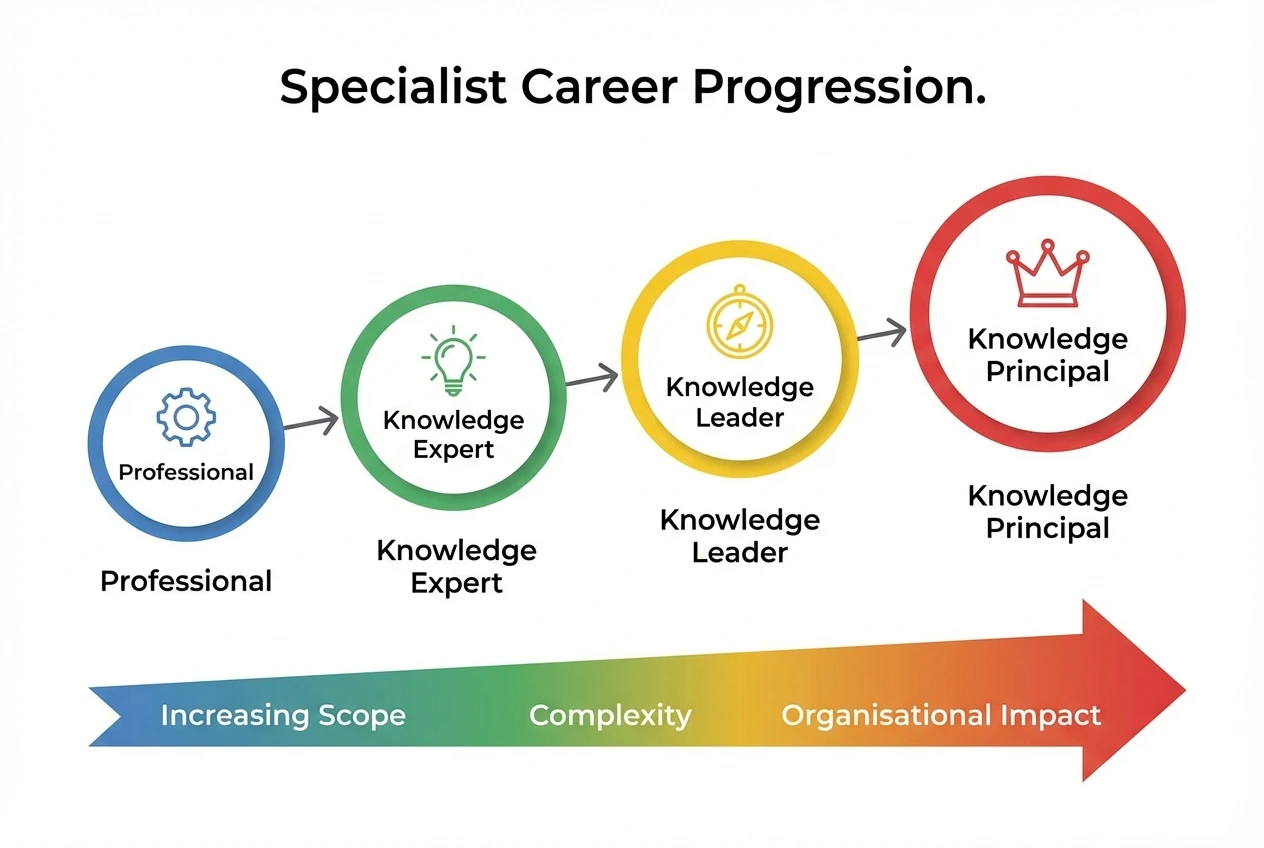
The Specialist Pipeline, developed by the Leadership Pipeline Institute, provides a structured framework for understanding specialist roles, progression, and development. It parallels the well-established Leadership Pipeline concept but focuses specifically on the progression of expertise rather than the expansion of management responsibility.
At its core, the Specialist Pipeline recognizes that specialists progress through increasingly complex levels of work, each requiring distinct skills, capabilities, and ways of creating value. Rather than measuring advancement through the size of teams managed, the Specialist Pipeline defines progression through:
- Complexity of problems addressed. Higher-level specialists tackle increasingly ambiguous, novel, or strategically significant technical challenges.
- Scope of technical impact. As specialists advance, their decisions influence progressively larger portions of the organization.
- Depth and breadth of expertise. Advanced specialists demonstrate mastery in narrow domains plus the ability to integrate knowledge across disciplines.
- Nature of decision-making. Professionals execute well-defined work. Knowledge Experts make consequential decisions with imperfect information. Knowledge Leaders and Principals shape strategy.
- Influence and knowledge transfer. Higher-level specialists serve as technical authorities, mentors, and knowledge multipliers.
Specialist Pipeline Passages
Professional
Executes defined technical tasks with supervision and develops foundational expertise
Knowledge Expert
Applies independent judgment, solves non-routine problems, and supports development of others
Knowledge Leader
Expands influence across projects or functions, integrating expertise and contributing to broader outcomes
Knowledge Principal
Shapes standards, strategy, and long-term capability—often influencing the enterprise or wider industry
What makes the Specialist Pipeline powerful is that it provides equivalency with management progression. A Knowledge Principal, for example, might be recognized as equivalent in seniority, compensation, and organizational influence to a Director-level or even VP-level manager—but without managing people. This creates genuine dual career paths rather than the hollow promise that specialists can advance without becoming managers.
Importantly, the Specialist Pipeline is not just a renaming exercise or a compensation structure. It fundamentally reframes how organizations think about specialist work, value creation, and career progression. It provides the foundation upon which effective Specialist Development Programmes can be built.
The Case for Specialist Development Programmes: Benefits vs. Risks
Understanding the Specialist Pipeline concept is one thing. Investing in comprehensive Specialist Development Programmes is another. Why should this be a strategic priority? The benefits are substantial, and the risks of inaction are severe.
Benefits of Implementing
Retention of Critical Expertise
Clear career paths and recognition equivalent to management tracks
Higher Engagement of Technical Talent
Specialists invest in deepening expertise rather than plotting exit strategies
Stronger Succession Planning
Identify high-potential specialists and deliberately develop capabilities
Clear Career Pathways Without Management
Genuine dual career paths based on technical excellence
Improved Capability and Innovation
Higher-level specialists mentor junior specialists and multiply capability
Enhanced Employer Brand
Organizations known for valuing specialists attract better technical talent
Risks of Not Implementing
Loss of Critical Experts
Without clear career paths, top specialists leave for competitors
Creation of Accidental Managers
Talented specialists accept management roles despite lacking interest or aptitude
Erosion of Competitive Advantage
Organizations gradually lose their edge to competitors who invest in specialists
Widening Capability Gaps
Gap between junior and senior specialists becomes a chasm
Institutional Knowledge Loss
Experienced specialists exit without structured knowledge transfer
The question is not whether your organization can afford to invest in Specialist Development Programmes. The question is whether you can afford not to. And perhaps most uncomfortably: if your top five specialists left tomorrow, could you even identify who should replace them, let alone ensure they're ready?
Designing Specialist Development Programmes: Key Implementation Stages
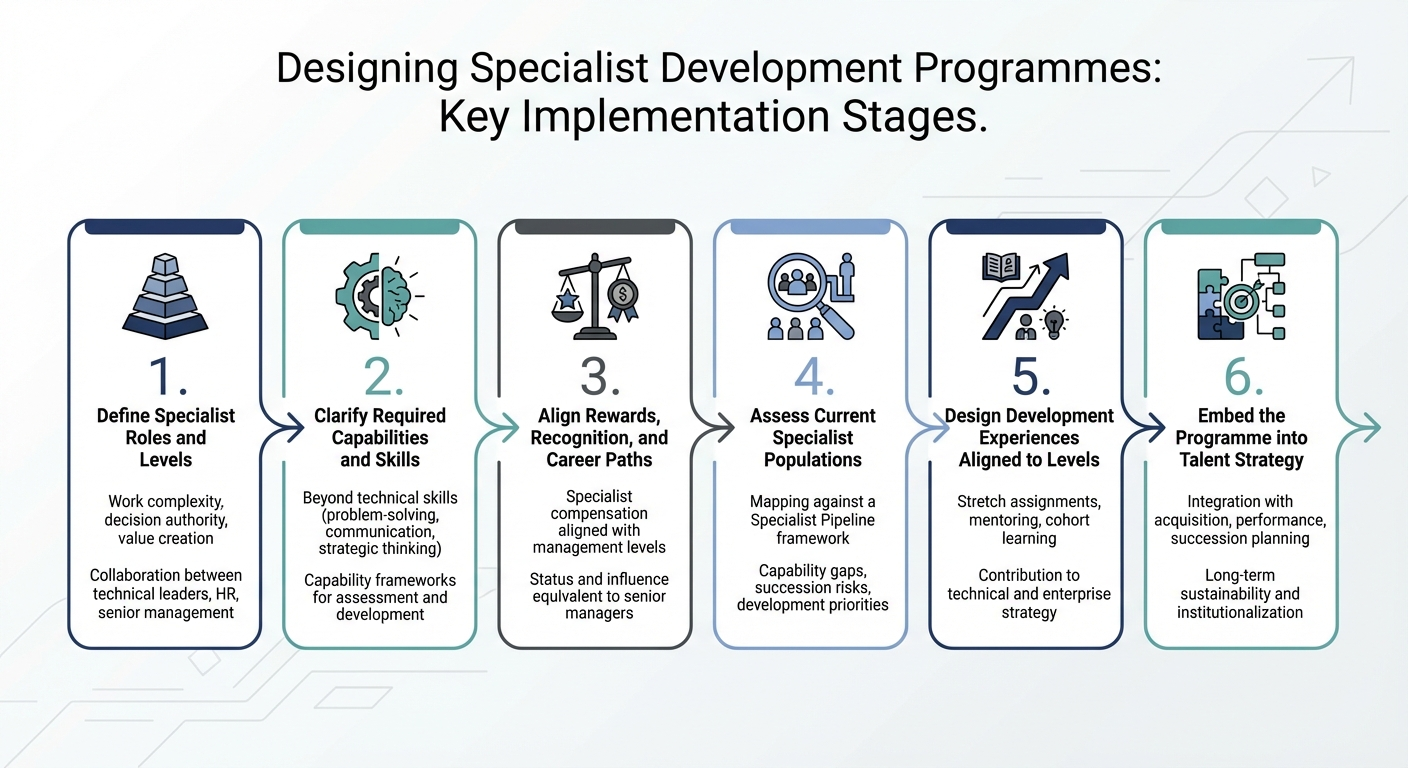
Implementing effective Specialist Development Programmes requires systematic effort across multiple stages. Organizations that treat this as a quick project or isolated initiative typically fail. Those that approach it as strategic talent architecture succeed. The Leadership Pipeline Institute, as the originator of the Specialist Pipeline concept, supports organizations through each stage of this journey.
Define Specialist Roles and Levels
- Articulate specialist levels based on work complexity, decision-making authority, and value creation
- Collaborate between technical leaders, HR, and senior management
Clarify Required Capabilities and Skills
- Specify capabilities beyond technical skills including problem-solving, communication, and strategic thinking
- Create capability frameworks for assessment and development planning
Align Rewards, Recognition, and Career Paths
- Ensure compensation bands for specialist levels are equivalent to comparable management levels
- Make organizational status and influence of senior specialists match senior managers
Assess Current Specialist Populations
- Map current specialists against the Specialist Pipeline framework
- Identify capability gaps, succession risks, and development priorities
Design Development Experiences Aligned to Levels
- Differentiate programmes by level with stretch assignments, mentoring, and cohort learning
- Create opportunities for specialists to contribute to technical strategy
Embed the Programme into Talent Strategy
- Integrate into talent acquisition, performance management, and succession planning
- Ensure sustainability so programmes become part of how the organization operates
Beyond the Basics: Additional Considerations for Specialist Development Programmes
Effective Specialist Development Programmes address several additional dimensions that determine success or failure.
Integration of Specialist and Leadership Pipelines
Specialist and leadership pipelines should not be separate, disconnected tracks. Organizations need to define how the pipelines relate, where transitions might occur, and how individuals can move between tracks without penalty. Some specialists eventually become effective managers—potentially progressing through the leader of leaders passage. Some managers return to specialist roles. The architecture should enable rather than restrict these movements while maintaining clarity about the distinct requirements of each track.
Cultural Barriers to Valuing Specialists
In many organizations, cultural norms subtly or overtly privilege management over specialist work. Executives are managers. Power flows through management hierarchies. Success means having direct reports. These cultural patterns undermine even well-designed specialist programmes. Addressing this requires visible leadership commitment, deliberate cultural change efforts, and structural decisions—often supported by talent engagement initiatives—that demonstrate genuine equivalence between specialist and management tracks.
How many of your senior specialists have the same access to executive leadership, strategic conversations, and organizational influence as your senior managers? If the answer is few or none, your organization has a cultural problem, not a programme design problem.
Measuring ROI of Specialist Development Programmes
Executives rightly ask about return on investment. Measuring specialist development ROI requires tracking multiple indicators across both leading and lagging measures:
Specialist Retention Rate
Compare high-performing specialists to baseline; expect improvement within 18 months
Time-to-Competency
Track development speed with structured programmes versus ad hoc development
Engagement Scores
Benchmark specialist engagement and satisfaction with career opportunities
Technical Decision Quality
Use peer review, project outcomes, and business impact metrics
Organizational Capability
Measure depth of expertise at each level and identify capability gaps
Regretted Attrition Cost
Calculate full cost of losing experts including recruitment, onboarding, and knowledge loss
Baseline required: The key is establishing baseline measurements before programme launch and tracking trends over 12–24 month periods. While some benefits take time to materialize, organizations that rigorously track these metrics consistently demonstrate positive returns from systematic specialist development.
Global vs. Local Considerations
For multinational organizations, specialist role definitions and career paths must balance global consistency with local market realities. Technical work may be globally standardized, but labor markets, cultural norms around career progression, and compensation practices vary significantly. Effective global Specialist Development Programmes establish consistent frameworks while allowing regional adaptation in implementation.
Moving Forward: The Strategic Imperative and Your Next Steps
The evidence is clear. Organizations in knowledge-intensive industries cannot afford to treat specialist development as an afterthought while their competitive advantage depends on technical expertise. The loss of critical specialists, the creation of accidental managers, the erosion of institutional knowledge, and the widening capability gaps are not hypothetical risks—they are occurring in organizations right now, including potentially yours.
Specialist Development Programmes built on the foundation of the Specialist Pipeline provide a proven framework for addressing these challenges. They offer clear role definitions, structured career paths, aligned development experiences, and genuine equivalence with management tracks. They retain critical expertise, engage top talent, strengthen organizational capability, and create competitive advantage.
But implementation requires commitment. It requires top management to prioritize specialist development as a strategic imperative. It requires HR and L&D leaders to invest time and resources in designing and executing comprehensive programmes. It requires organizational willingness to change cultural norms that privilege management over expertise—sometimes leveraging tools like the PI Behavioral Assessment to understand individual drives. And it requires sustained effort to embed these programmes into talent architecture, not treat them as one-time initiatives.
The question for executive leaders is direct: Can your organization articulate a clear strategy for retaining, developing, and advancing your critical specialists? If your answer is uncertain or negative, the strategic risk is real and growing.
About Progressica
Progressica, as a partner of the Leadership Pipeline Institute, supports organizations in designing and implementing Specialist Development Programmes that deliver measurable impact. Our approach combines the rigor of the Specialist Pipeline framework with practical expertise in talent strategy, organizational development, and programme execution.
We work with top management, HR Directors, and L&D leaders to:
- Define specialist roles and Specialist Pipeline structures aligned to your organizational context and industry.
- Clarify required capabilities and success criteria at each specialist level.
- Design comprehensive development programmes with differentiated experiences for specialists at different levels.
- Assess current specialist populations and identify development priorities.
- Align rewards, recognition, and career paths to support genuine dual-track progression.
- Build internal capability to sustain and evolve Specialist Development Programmes over time.
The specialists who drive your organizational capability, create your competitive advantage, and represent your institutional knowledge are too valuable to lose through strategic neglect. Together with the Leadership Pipeline Institute, we bring proven frameworks and practical experience to help you make specialist development a strategic strength, not a strategic vulnerability.

Founder & Principal Consultant
MSc in I/O Psychology, 13+ years in leadership roles with A.P. Moller Group, now advising global organizations on talent strategy.
Progressica partners with medium and large organizations to design and implement strategic talent development solutions. As a certified partner of the Leadership Pipeline Institute, Progressica specializes in building leadership and specialist pipelines that drive organizational capability and competitive advantage.