The problem with most team decisions
Most team composition decisions are made without behavioral data
When organisations build teams, restructure functions, or assign strategic initiatives, the decisions are typically made based on availability, seniority, and track record. These are reasonable inputs — but they tell you nothing about how a group of people will actually work together, how they will respond to pressure, or whether their collective behavioral profile matches the demands of the strategy they are being asked to execute.
The result is predictable: talented individuals who produce average results as a team. Not because they are the wrong people, but because nobody looked at the behavioral dynamics before the team was formed.
Without behavioral team data
Teams are built around availability and org chart logic
Collaboration friction is only visible after it becomes a problem
Strategic misalignment is diagnosed as a leadership or motivation issue
Restructuring decisions rely on instinct and politics
With behavioral team data
You see whether your team's profile matches your strategic priorities before execution begins
Friction points are identifiable and addressable before they compound
You have objective data to support restructuring, role changes, and team design decisions
Leaders have a shared language for how their team works and what it needs
What the software does
Four ways to understand and improve how your teams work
Team behavioral profile
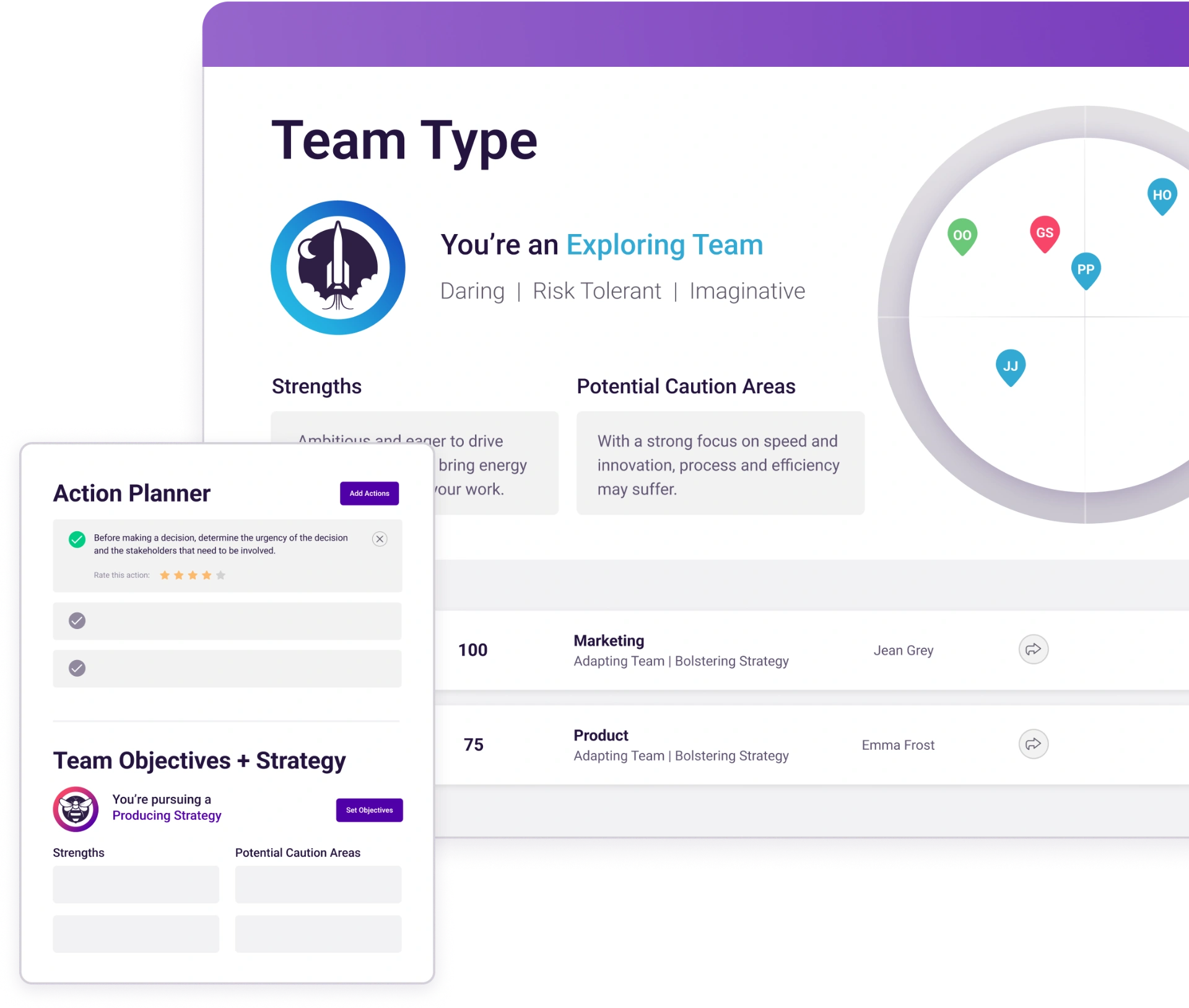
Map your entire team's behavioral composition — natural working styles, decision-making tendencies, risk tolerance, and collaboration preferences — in a single view.
Strategy-to-team alignment
See whether your team's behavioral profile supports or works against your current strategic priorities. Understand where the gaps are before execution stalls. How behavioral assessments work →
Friction and gap analysis
Identify behavioral blind spots, overplayed tendencies, and missing strengths that create friction or limit the team's effectiveness.
Team design and restructuring support
Use behavioral data to inform role changes, team restructuring, new hire decisions, and how work is allocated — so changes are grounded in evidence, not intuition.
From features to real results
What leaders see differently with team alignment software
Clearer team decisions
Whether you are forming a new team, restructuring an existing one, or adding a hire, behavioral data gives every decision a more reliable foundation than availability and gut feel alone.
Earlier diagnosis of team problems
Friction, underperformance, and disengagement often have behavioral root causes that become visible in the data before they become visible in results. Earlier diagnosis means earlier intervention.
Better strategy execution
When a team's behavioral composition is aligned to the strategic demands of their work, execution improves — not because people work harder, but because the right behavioral strengths are in the right places.
The process
From team assessment to actionable alignment insight
Assess your team
Each team member completes a validated behavioral assessment — approximately 6 minutes, untimed, no right or wrong answers. The team profile is generated immediately.
Map your team's behavioral composition
The platform produces a visual map of how your team is collectively composed — working styles, decision-making tendencies, and collaboration dynamics at a glance.
Define your strategic context
Select the strategic type that best describes what your team needs to deliver. The platform maps your team's profile against it.
Identify alignment and gaps
See where your team's behavioral strengths support your strategy and where gaps or misalignments exist. Each gap comes with context — what it means and what can be done about it.
Design your response
Use the insight to inform team restructuring, role allocation, new hire decisions, or targeted development — with objective data to support every decision.
Is this right for you
Is your organisation ready to build teams with better data?
Team alignment software is relevant to any organisation that forms teams, restructures functions, or assigns people to strategic work. The question is whether your organisation is ready to use behavioral data to make those decisions more deliberately.
See it live
See the Platform in a Demo Built Around One of Your Real Teams
We walk you through the platform using your actual team context — not generic examples. Bring a real team you want to understand better, or a strategic initiative you are trying to staff correctly.
Map a sample team's behavioral composition and walk through what it reveals
See how the platform aligns a team profile to a specific strategy type
Walk through a gap analysis — what the team has, what it is missing, and what that means
Understand pricing, onboarding, and what getting started looks like for your organisation
Common questions
Frequently asked
The case for building teams with better data
Most team problems are visible in the behavioral data before they become visible in results. Team alignment software gives leaders the insight to build, restructure, and lead teams more deliberately — so that strategic decisions about people are grounded in evidence, not intuition.

Founder & Principal Consultant
MSc in I/O Psychology, 13+ years in leadership roles with A.P. Moller Group, now advising global organizations on talent strategy.