Contents
Hiring the right people remains one of the most complex and high-impact responsibilities facing organizations today. Despite advances in recruiting technology, many companies still rely heavily on résumés, interviews, and intuition to make employment decisions. While these tools provide useful information, they often fail to explain how individuals will actually behave at work—how they respond to pressure, interact with others, manage pace and change, and make decisions day after day. This is why data-driven hiring has become increasingly important.
For HR leaders, misalignment between role requirements and employee behavior can result in lower productivity, disengagement, higher turnover, and increased hiring costs. For candidates, unclear or subjective evaluation processes can lead to poor job fit, dissatisfaction, and stalled career growth, even when they appear well qualified on paper.
The PI Behavioral Assessment™ helps address these challenges by providing a structured, scientifically grounded way to understand workplace behavior. Developed in 1955 by Arnold S. Daniels, a pioneer in applied behavioral science, the assessment emerged from research conducted with the U.S. Army Air Corps, where Daniels demonstrated that consistent patterns of behavior could be reliably measured and applied to predicting performance.
This work led to the creation of The Predictive Index® (PI) and one of the earliest commercially available behavioral surveys designed specifically for the workplace. Over time, the PI Behavioral Assessment™ has been refined to strengthen its psychometric properties, update language norms, and ensure relevance for modern organizations.
Today, the PI Behavioral Assessment™ is used by organizations of all sizes across more than 140 countries. Available in over 70 languages, it supports smarter hiring, leadership development, team effectiveness, and employee engagement—making it one of the most widely adopted behavioral assessment tools in the world.
This guide is written as a client-facing resource for:
- HR leaders and hiring managers seeking a consistent, defensible approach to talent decisions
- Candidates who want transparency about what the assessment measures and how it is used
In Brief
The PI Behavioral Assessment™ is a 5–10 minute, untimed self-report survey that measures four primary behavioral factors—Dominance, Extraversion, Patience, and Formality—plus a secondary factor called Objectivity. It is not a test of intelligence or skills; it predicts motivational drives and workplace behaviors to help organizations make better hiring, development, and team decisions.
Key Takeaways
- The PI Behavioral Assessment™ is a self-report workplace behavioral survey—not a test of intelligence, skills, or mental health.
- It measures four primary factors (Dominance, Extraversion, Patience, Formality) plus a secondary factor (Objectivity) that describes decision-making orientation.
- Completion takes approximately 5–10 minutes, is untimed, and requires no preparation.
- There is no pass or fail—results describe behavioral drives to support role-fit alignment.
- Authentic responses lead to better outcomes for both candidates and employers.
- The assessment aligns with EEOC, APA, SIOP, and ITC guidelines and has been certified under the EFPA Test Review Model.
- It is available in over 70 languages across 140+ countries.
Self-report behavioral survey
~5–10 minutes, untimed
Motivational drives + workplace behaviors
Intelligence, skills, experience, or mental health
Hiring, onboarding, leadership, teams
What Is the PI Behavioral Assessment™?
The PI Behavioral Assessment™ (BA) is a self-report workplace behavioral survey used in hiring, onboarding, leadership development, and workforce planning. It is not a clinical personality test, and it does not measure intelligence, cognitive ability, job skills, experience, or mental health.
Instead, it is specifically designed to predict motivational drives and observable working behaviors—how individuals are naturally motivated at work and how those motivations influence their day-to-day behavior, communication style, pace, and decision-making.
The survey is completed online, is untimed, and typically takes approximately 5–10 minutes. There is no preparation required, and there are no correct or incorrect answers.
For employers, the PI Behavioral Assessment™ adds an objective layer of insight that traditional hiring tools often miss. For candidates, it provides a consistent and transparent way to be evaluated based on authentic work style rather than interview performance alone.
How the Behavioral Survey Works
The PI Behavioral Assessment™ uses a free-choice response format. Participants are presented with descriptive adjectives and asked to select those that best represent:
- How they feel others expect them to behave at work
- How they feel they naturally behave
This structure captures both situational expectations and underlying behavioral drives. The responses are analysed to identify stable behavioral patterns that are relevant to workplace performance.
The survey does not rank individuals or label behaviors as "good" or "bad." Different roles and environments require different behavioral strengths. The value of the assessment lies in alignment—matching people to roles and environments where their natural motivations and working behaviors are most likely to lead to success.
What It Measures
- Drives and behaviors: How individuals are naturally motivated at work
- Communication style: Preference for directness vs. diplomacy
- Pace and change preference: Stability vs. urgency and variety
- Decision orientation: Data-driven vs. intuitive approaches
What It Does NOT Measure
- Clinical personality or mental health
- Intelligence or cognitive ability
- Job skills, experience, or domain expertise
- Mental health conditions or diagnoses
The Four Primary Behavioral Factors
The PI Behavioral Assessment™ measures four primary independent behavioral factors that together provide a comprehensive picture of workplace behavior and motivation.
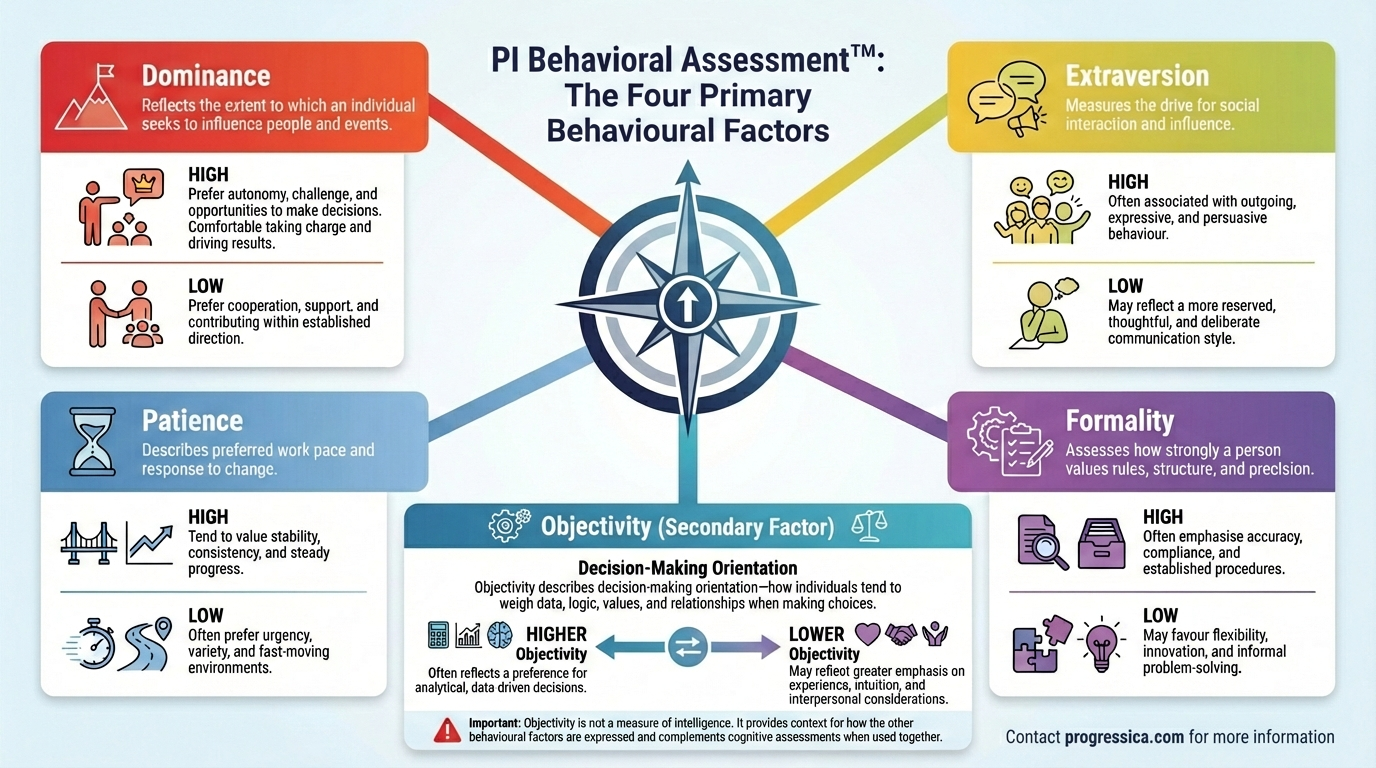
Dominance
Reflects the extent to which an individual seeks to influence people and events.
Prefer autonomy, challenge, and opportunities to make decisions. Comfortable taking charge and driving results.
Prefer cooperation, support, and contributing within established direction.
Extraversion
Measures the drive for social interaction and influence.
Often associated with outgoing, expressive, and persuasive behavior.
May reflect a more reserved, thoughtful, and deliberate communication style.
Patience
Describes preferred work pace and response to change.
Tend to value stability, consistency, and steady progress.
Often prefer urgency, variety, and fast-moving environments.
Formality
Assesses how strongly a person values rules, structure, and precision.
Often emphasise accuracy, compliance, and established procedures.
May favour flexibility, innovation, and informal problem-solving.
Both approaches can be highly effective, depending on role expectations and organizational culture. Understanding these preferences helps managers tailor communication, collaboration, and feedback approaches.
Objectivity (Secondary Factor)
Decision-Making Orientation
Objectivity describes decision-making orientation—how individuals tend to weigh data, logic, values, and relationships when making choices. Higher Objectivity often reflects a preference for analytical, data-driven decisions. Lower Objectivity may reflect greater emphasis on experience, intuition, and interpersonal considerations.
Important: Objectivity is not a measure of intelligence. It provides context for how the other behavioral factors are expressed and complements cognitive assessments when used together.
Guidance for Candidates Completing the Survey
There Is No Pass or Fail
The PI Behavioral Assessment™ cannot be passed or failed. Results are not scores to beat or thresholds to meet. The purpose is to describe motivational drives and working behaviors so that better alignment can be achieved between people, roles, and environments.
In order for the PI Behavioral Assessment™ to be used in the hiring and selection process, the stakeholder must establish a benchmark known as a Behavioral Job Target using the Predictive Index Job Assessment.
Authentic Responses Lead to Better Outcomes
Candidates are encouraged to complete the survey independently and honestly. Attempting to answer based on what an employer "might want" often results in inaccurate profiles, increasing the likelihood of poor role fit. When results accurately reflect real workplace behavior, candidates are more likely to be matched with roles where they can perform naturally, feel engaged, and grow over time.
Why HR Leaders Use the PI Behavioral Assessment™
When integrated thoughtfully into a broader talent strategy, the PI Behavioral Assessment™ supports more informed decision-making across the employee lifecycle.
Smarter Hiring Decisions
Predict how candidates are likely to approach their work—not just whether they can do the job.
Reduced Turnover
Improved alignment between role demands and behavioral motivations leads to higher engagement and retention.
Stronger Team Performance
Behavioral insight improves communication, collaboration, and conflict management.
Leadership Development
Behavioral patterns highlight natural tendencies and development opportunities for targeted coaching.
Objective Processes
Using a structured behavioral survey supports consistency and fairness, reducing reliance on subjective impressions.
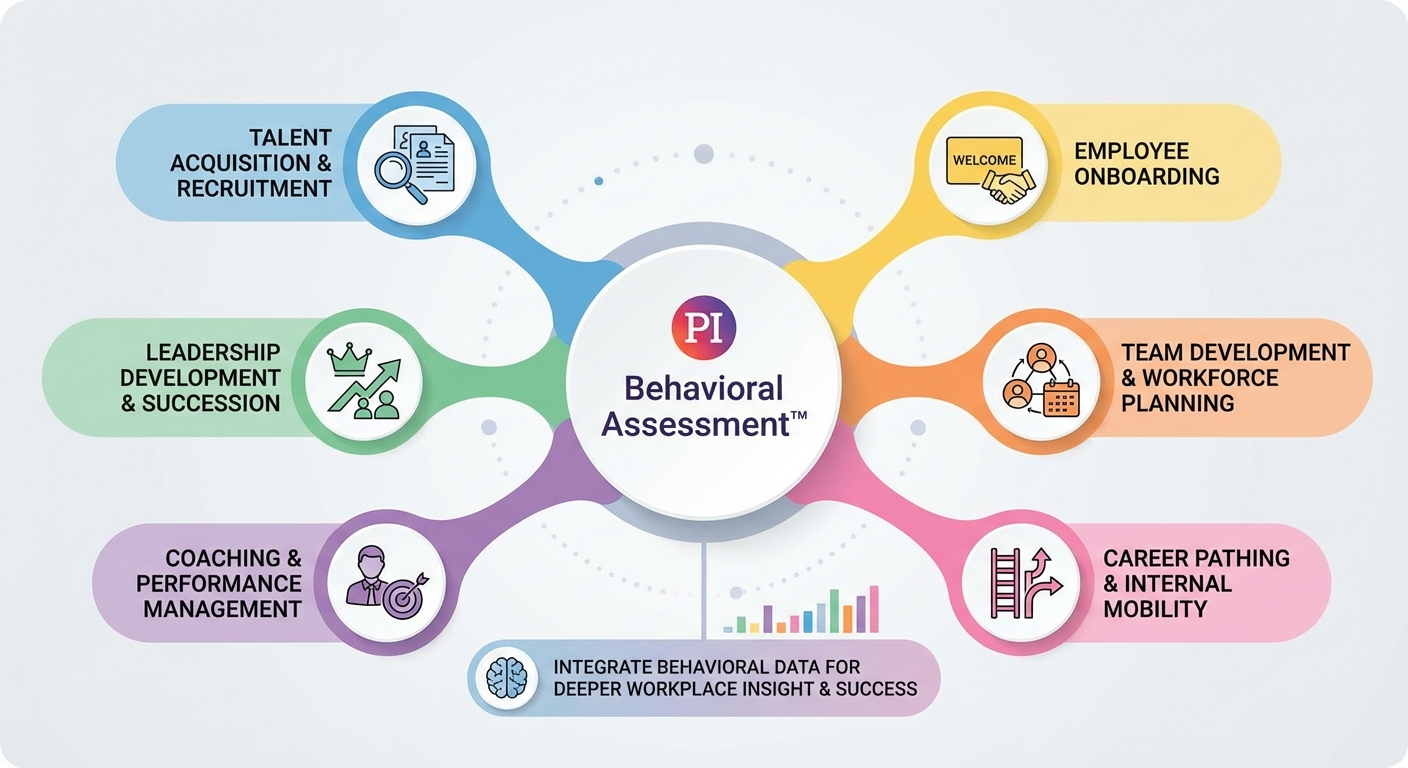
Applications Across Talent Management
The PI Behavioral Assessment™ is commonly used across a wide range of HR and talent initiatives, including:
By integrating behavioral data into these processes, organizations gain deeper insight into how people work and where they are most likely to succeed.
Validity, Reliability, and Professional Standards
The PI Behavioral Assessment™ is grounded in decades of behavioral science research and ongoing psychometric evaluation.
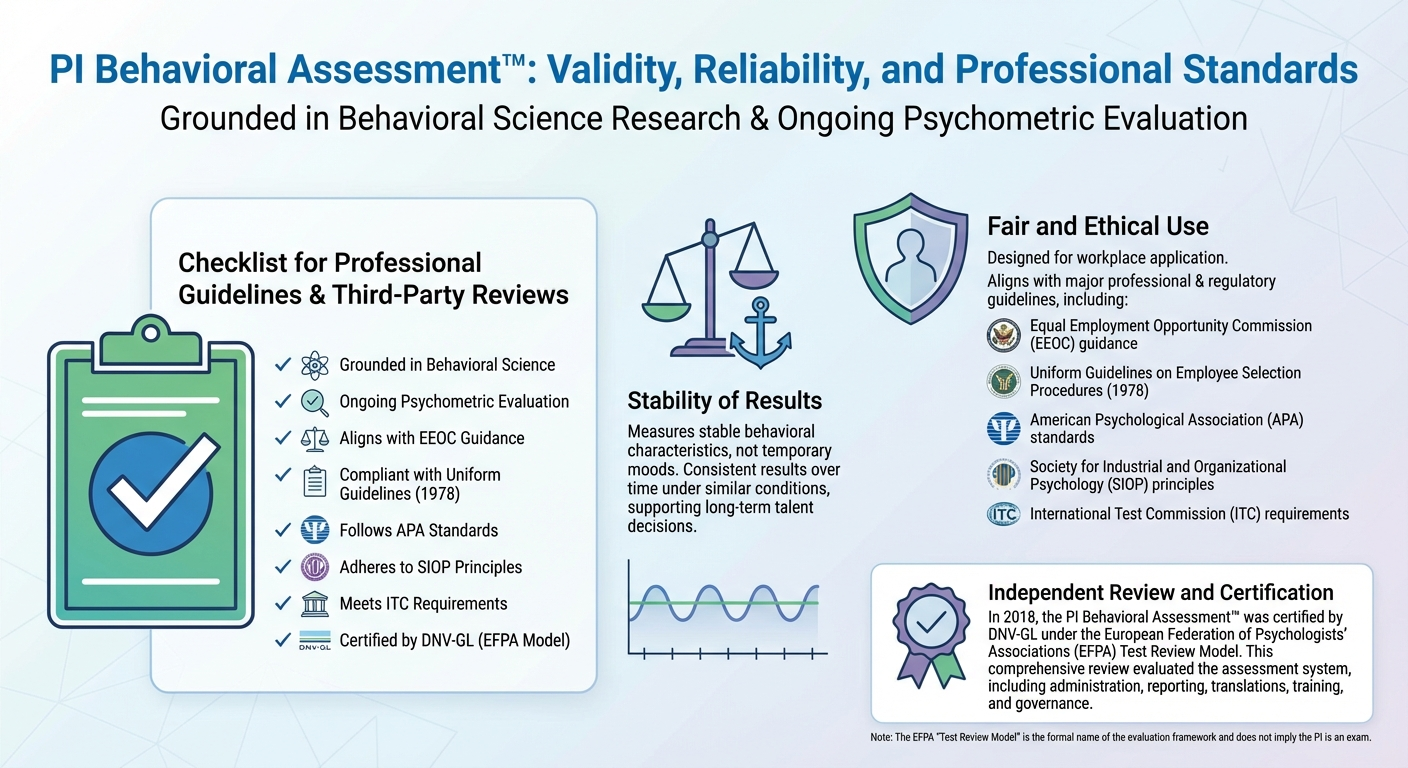
Stability of Results
Research indicates that the assessment measures stable behavioral characteristics rather than temporary moods or situational states. When completed under similar conditions, results remain consistent over time, supporting its use in long-term talent decisions.
Fair and Ethical Use
The assessment is designed for workplace application and aligns with major professional and regulatory guidelines, including:
- Equal Employment Opportunity Commission (EEOC) guidance
- Uniform Guidelines on Employee Selection Procedures (1978)
- American Psychological Association (APA) standards
- Society for Industrial and Organizational Psychology (SIOP) principles
- International Test Commission (ITC) requirements
Independent Review and Certification
In 2018, the PI Behavioral Assessment™ was certified by DNV-GL under the European Federation of Psychologists' Associations (EFPA) Test Review Model. This comprehensive review evaluated the assessment system, including administration, reporting, translations, training, and governance.
Note: The EFPA "Test Review Model" is the formal name of the evaluation framework and does not imply the PI is an exam.
Global Reach and Accessibility
The PI Behavioral Assessment™ is available in more than 70 languages, supporting consistent use across global organizations. Extensive normative data allows results to be interpreted appropriately across roles, industries, and regions.
140+ Countries
Global organizational reach
70+ Languages
Available translations
FAQ: PI Behavioral Assessment™ for Hiring
Is the PI Behavioral Assessment™ a test?
No. It is a self-report workplace behavioral survey designed to predict motivational drives and working behaviors. It is not an exam and cannot be passed or failed.
How long does it take to complete?
Most candidates complete the survey in 5–10 minutes. It is untimed and requires no preparation.
What does the PI Behavioral Assessment™ measure?
It measures four independent behavioral factors—Dominance, Extraversion, Patience, and Formality—that describe workplace behavior and decision-making orientation, plus a secondary factor called Objectivity.
Should the PI Behavioral Assessment™ be used alone in hiring?
No. It is most effective when used as part of a holistic hiring process that includes interviews, skills evaluation, and experience review.
Is the PI Behavioral Assessment™ fair and legally defensible?
Yes, when used appropriately. It aligns with major professional and regulatory guidelines and has undergone independent third-party review.
Which languages can the PI Behavioral Assessment™ be taken in?
It is available in more than 70 languages. See the Languages Available section above for the complete list.
Conclusion
The PI Behavioral Assessment™ for Employment is a proven behavioral survey designed to predict motivational drives and working behaviors, helping organizations and candidates make better, more informed decisions about role fit and work environment alignment.
By measuring four independent behavioral factors plus a secondary factor, the assessment provides objective insight into how individuals work, communicate, and make decisions—information that traditional hiring tools often miss.
For HR leaders, it supports smarter hiring, stronger teams, and more targeted development. For candidates, it offers a transparent and consistent way to be evaluated based on authentic work style rather than subjective impressions.
When used as part of a thoughtful, holistic talent strategy, the PI Behavioral Assessment™ helps align people with roles and environments where they can perform at their best—driving engagement, effectiveness, and long-term organizational success.

Founder & Principal Consultant
MSc in I/O Psychology, 13+ years in leadership roles with A.P. Moller Group, now advising global organizations on talent strategy.
Use Behavioral Insight with Clarity and Fairness
The PI Behavioral Assessment™ helps you make data-driven talent decisions that are consistent, defensible, and aligned to role requirements. Talk to us about how behavioral data can support smarter hiring and stronger teams.
Global Talent Assessment Provider
Progressica is a certified partner of The Predictive Index, delivering science-backed talent assessment solutions across Europe and beyond. We help organizations use behavioral and cognitive data to make smarter decisions about hiring, development, and team performance.
Related Insights
PI Cognitive Assessment™: A Strategic Tool for Smarter Hiring and Talent Decisions
Predictive Index Design: the complete guide to PI's team optimization module