Contents
In many organizations, talent systems remain heavily weighted toward leadership and people management. Advancement, recognition, and rewards are often linked to increasing span of control, while those who create value through deep expertise face unclear or inconsistent career paths. Yet in today's knowledge-intensive, regulated, and innovation-driven environment, specialists — scientists, engineers, analysts, clinicians, technologists, and other experts — are central to sustainable performance.
The Specialist Pipeline Concept directly addresses this imbalance. It provides a structured framework for specialist development, enabling organizations to grow, deploy, and retain expert talent with the same discipline traditionally reserved for leadership pipelines. Instead of pushing specialists into management roles to progress, the Specialist Pipeline Concept makes expert growth visible, valued, and measurable. Effective succession planning for specialists depends on this framework.
Progressica is a partner of Leadership Pipeline Institute, the originator of the Specialist Pipeline Concept, and works with organizations to design and deliver effective specialist development programs aligned with business strategy. Contact Progressica to learn more.
In Brief
The Specialist Pipeline Concept offers a structured framework for developing expert talent, mirroring the leadership pipeline architecture but designed specifically for roles where value is created through expertise rather than hierarchical authority. It defines clear progression passages based on increasing complexity, judgment, and organizational impact, supported by three foundational dimensions: skills, time application, and work values. Organizations that implement this framework—alongside talent assessments—can retain critical expertise, improve decision quality, and create sustainable competitive advantage without forcing specialists into management roles.
Key Takeaways
- The Specialist Pipeline Concept provides structured career paths for experts without requiring management responsibility
- Specialist progression is based on complexity of problems solved, judgment applied, and organizational impact delivered
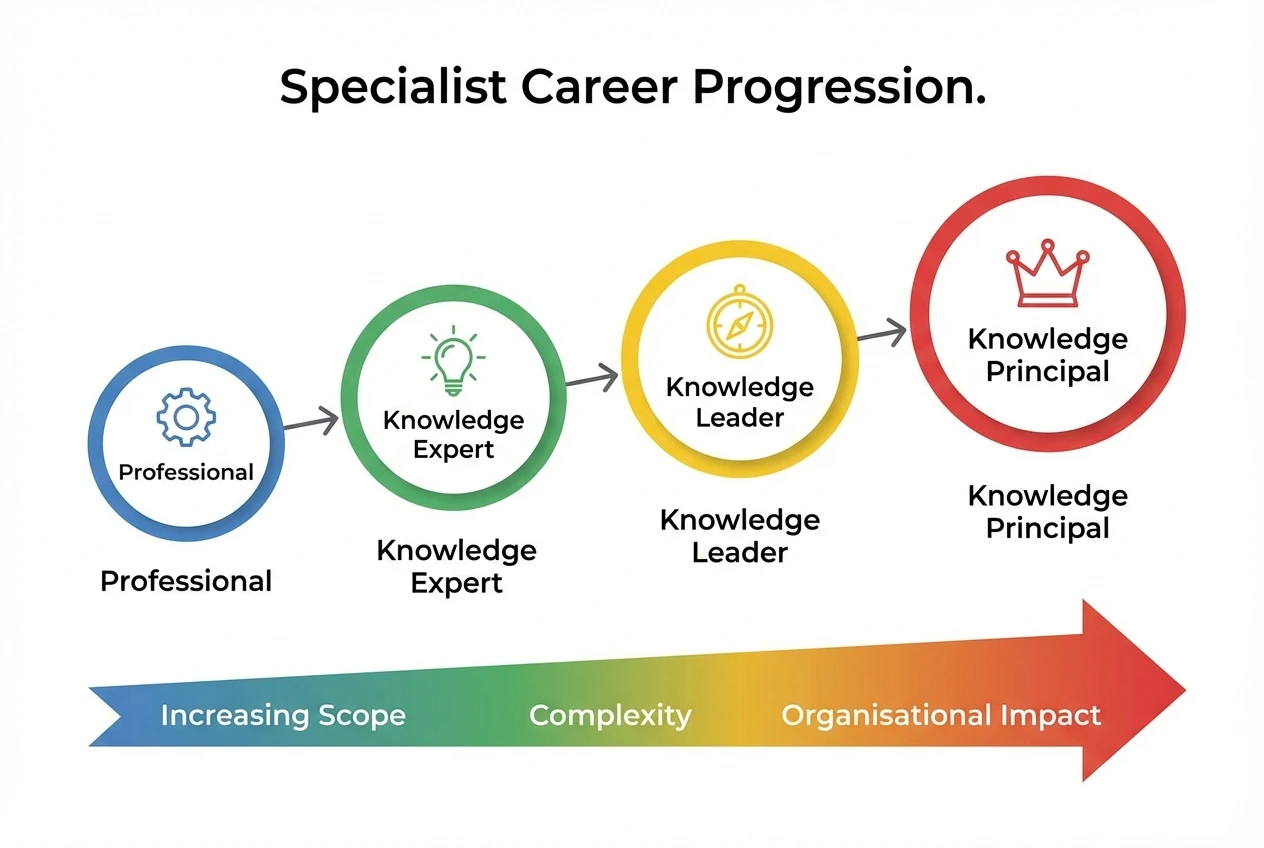
- Three passages define specialist growth: Professional → Knowledge Expert → Knowledge Leader → Knowledge Principal
- Skills, time application, and work values are the three foundations of effective specialist development
- Ignoring specialist development leads to knowledge loss, reduced innovation, and inappropriate promotions
- Leading organizations like Amazon, Google, Roche, and Novartis already apply structured specialist career frameworks
The Problem
Most talent frameworks equate career progression with increasing authority over people. Specialists who excel through deep expertise face a stark choice: move into management (often unsuited to their strengths) or accept career stagnation. This leadership-centric model undermines expert value creation, drives disengagement, and causes organizations to lose mission-critical knowledge when senior specialists leave.
What Is the Specialist Pipeline Concept?
The Specialist Pipeline Concept is similar to the Leadership Pipeline architecture, specifically designed for roles where value is created through expertise rather than hierarchical authority. It defines how specialists progress over time by increasing:
Complexity of Problems
The scope and difficulty of challenges specialists address
Judgment Applied
The depth of independent decision-making and problem framing
Organizational Impact
The scale and strategic value of contributions delivered

At its core, the Specialist Pipeline Concept clarifies:
- •Distinct levels of specialist contribution
- •Clear passages between those levels
- •The required skills, time application, and work values at each stage
This approach shifts specialist roles away from static job descriptions toward dynamic value-creation roles. Progression is no longer based on tenure, informal reputation, or title inflation, but on demonstrable increases in capability, accountability, and influence.
Why Specialist Development Is Now Critical
Specialist Development has become a strategic priority as organizations face:
- •Rapid technological and scientific advancement
- •Increasing regulatory, safety, and compliance requirements
- •Greater complexity across systems, products, and services
- •Heightened expectations for quality, ethics, and innovation
Despite this reality, many organizations unintentionally undermine specialist effectiveness by:
- •Treating specialist roles as end points rather than growth paths
- •Creating "expert" titles without clear expectations or authority
- •Investing heavily in leadership development while neglecting specialist development
- •Promoting specialists into people-management roles as the only visible route to progression
The result is disengagement, loss of critical expertise, and weakened decision quality. The Specialist Pipeline Concept enables organizations to retain deep expertise while strengthening overall capability.
Why Many Organizations Overlook Specialist Development
The absence of deliberate specialist development is rarely intentional. It is usually driven by structural and cultural factors, including:
1Leadership-Centric Talent Models
Many talent frameworks equate influence with authority over people, making specialist contribution harder to define and reward.
2Lack of Role and Progression Clarity
Without a Specialist Pipeline Concept, organizations struggle to distinguish between experience, expertise, and enterprise-level impact.
3Limited Capability to Lead Specialists
Managers are often unprepared to develop specialists whose technical depth exceeds their own.
4Misaligned Reward and Promotion Systems
Compensation and recognition frequently lag behind the value specialists deliver, reinforcing the belief that management is the only path to advancement.
A clearly articulated Specialist Pipeline Concept provides the structure and language needed to overcome these barriers.
The Organizational Cost of Ignoring Specialists
Failing to invest in specialist development carries significant and often hidden risks:
Hidden Costs of Ignoring Specialists
- Loss of mission-critical knowledge when senior specialists disengage or leave
- Reduced innovation and problem-solving capacity
- Poor technical, scientific, or regulatory decisions
- Burnout among key experts who are relied upon but not developed
- Inappropriate promotions that weaken both specialist and leadership capability
In sectors such as pharmaceuticals, healthcare, energy, advanced manufacturing, and financial services, these risks directly affect safety, compliance, quality, and long-term competitiveness.
Specialist Passages: How Expertise Grows
A defining feature of the Specialist Pipeline Concept is the idea of passages. A passage represents a fundamental shift in how a specialist creates value, not simply a change in title or seniority.

Typical passages include:
1. Professional to Knowledge Expert
Specialists move from executing defined tasks to applying independent judgment, solving non-routine problems, and supporting the development of others.
2. Knowledge Expert to Knowledge Leader
Specialists expand their influence across projects or functions, integrating expertise and contributing to broader organizational outcomes.
3. Knowledge Leader to Knowledge Principal
At the most senior levels, specialists shape standards, strategy, and long-term capability, often influencing the enterprise or wider industry.
Effective specialist development programs focus explicitly on supporting these passages.
Skills, Time Application, and Work Values: The Foundation of Specialist Development
The Specialist Pipeline Concept is grounded in three interdependent dimensions that define effective specialist performance at every level.
3 Foundations of Specialist Development
Skills
- • Professional judgment
- • Systems thinking
- • Influence without authority
- • Coaching capability
- • Decision-making under uncertainty
Time Application
- • Early-career: execution and learning
- • Mid-level: problem solving and advising
- • Senior: shaping standards and mentoring
Work Values
- • From personal task mastery
- • To stewardship of knowledge
- • Accountability for outcomes
- • Professional and ethical standards
Misalignment of time application is one of the most common barriers to effective specialist development. Successful specialist development programs explicitly support value shifts as specialists move through the pipeline.
Signals from Leading Organizations
Several well-known organizations demonstrate the power of structured specialist development.
Technology Sector
Companies such as Amazon, Google, Meta, and Apple maintain senior individual-contributor roles like Principal and Distinguished Engineer that are among the highest-paid positions in the organization.
These roles reflect enterprise-wide impact rather than people management.
Pharmaceutical Sector
Companies such as Roche and Novartis provide strong examples through roles like Distinguished Scientist and Scientific Fellow.
These specialists are accountable for scientific strategy, regulatory judgment, and long-term research capability—compensated at levels comparable to senior executives.
These examples show that organizations applying the Specialist Pipeline Concept deliberately protect and leverage deep expertise.
Making the Specialist Pipeline Concept Real
Implementing the Specialist Pipeline Concept is not about adding titles or parallel hierarchies. It requires disciplined organizational work, including:
- Defining specialist roles based on value creation
- Clarifying expectations for skills, time application, and work values
- Aligning performance management and rewards with specialist contribution
- Designing targeted specialist development programs for key passages
- Building leader capability to support and leverage specialists effectively
When implemented well, the Specialist Pipeline Concept creates clarity, fairness, and motivation for specialists, while strengthening organizational performance.
Partner with Progressica
Progressica helps organizations bring the Specialist Pipeline Concept to life through practical, scalable specialist development programs. As a partner of Leadership Pipeline Institute, we combine proven frameworks with deep experience in leadership and specialist development.
We work with leaders and HR teams to:
- Diagnose gaps in specialist capability
- Design clear specialist roles and passages
- Build targeted specialist development programs
- Strengthen long-term organizational capability
If your organization depends on deep expertise, innovation, and sound judgment, investing in the Specialist Pipeline Concept is no longer optional. Explore how we can help you develop, retain, and fully leverage your specialists for sustainable success.
Written by

Founder & Principal Consultant
MSc in I/O Psychology, 13+ years in leadership roles with A.P. Moller Group, now advising global organizations on talent strategy.