Contents
In Brief
Succession planning for specialists requires a structured approach that goes beyond traditional leadership pipelines. By identifying critical specialist roles, mapping knowledge dependencies, and creating development pathways, organizations can ensure continuity of expertise and reduce the risk of knowledge loss when key specialists transition or depart. The Specialist Pipeline Concept provides the structural foundation for this work.
Key Takeaways
- Specialist succession planning is distinct from leadership succession—it focuses on preserving deep expertise rather than filling hierarchical positions
- Identifying critical specialist roles and mapping knowledge dependencies is the essential first step
- A structured 11-step framework covers everything from role identification through knowledge transfer and continuous improvement
- The Specialist Pipeline Concept provides the structural foundation for effective specialist succession
- Organizations that neglect specialist succession risk losing irreplaceable institutional knowledge and competitive advantage
Succession planning is a vital process that ensures the continuity of an organization's key functions and the preservation of its valuable expertise. A robust succession plan is especially important for specialists – employees with niche skills and knowledge that are critical to an organization's success. Understanding the Specialist Pipeline Concept provides the structural foundation for effective succession planning.
The Critical Role of Specialists
Specialists occupy unique positions within organizations, possessing in-depth knowledge and expertise that can be difficult to replace. Their roles may involve:
11 Essential Steps for Success
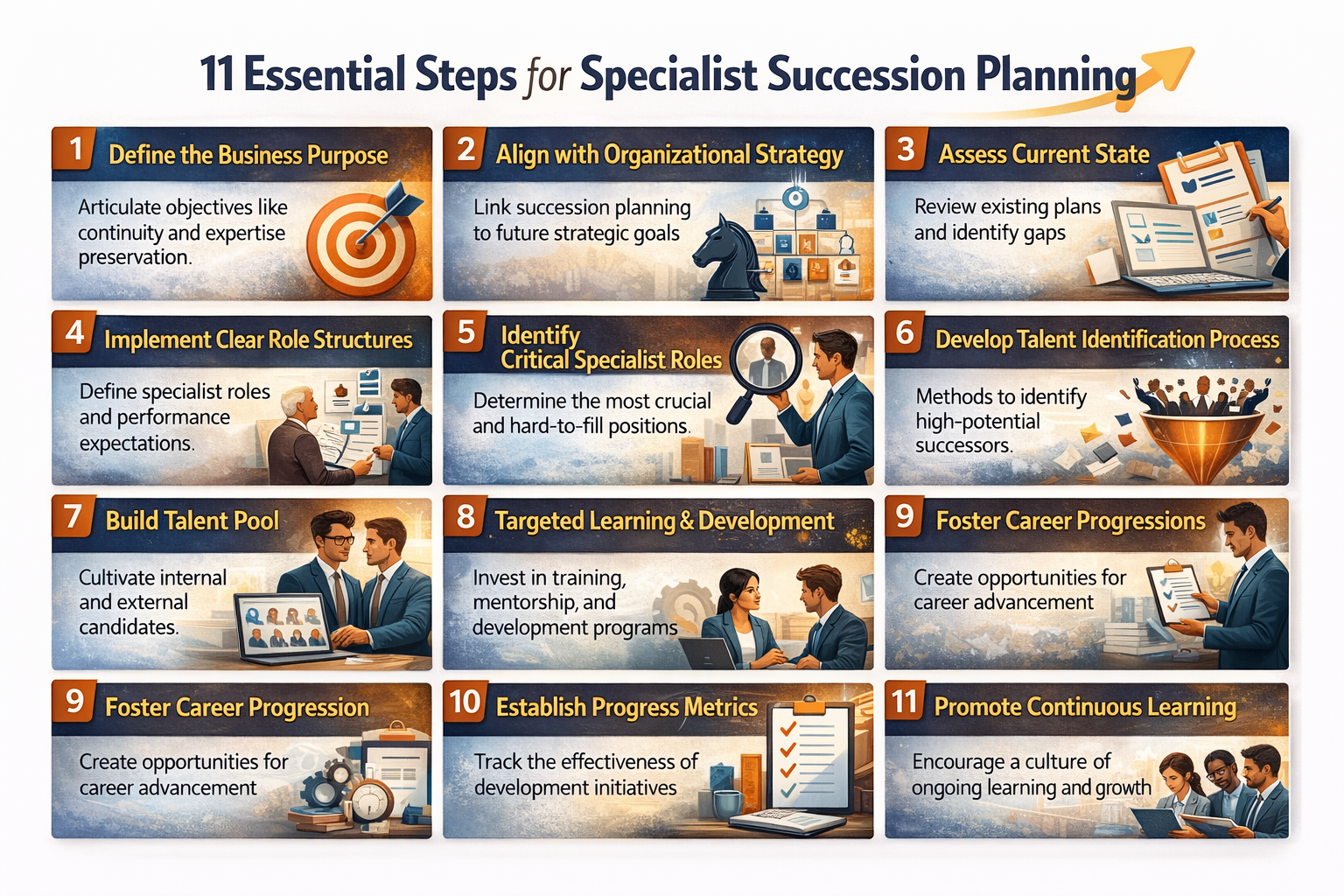
Define the Business Purpose
Begin by clearly articulating the business purpose of specialist succession planning. This may include objectives such as ensuring the continuity of critical functions, preserving valuable expertise, or maintaining the organization's competitive edge. Specialist development programmes should support these objectives.
Align with Organizational Strategy
Review the organization's overall strategy and identify how specialist succession planning can support its strategic objectives. Focus on innovation, growth, and maintaining a pipeline of skilled specialists.
Assess Current State
Evaluate your existing succession plans, whether formal or informal, for specialist roles. Identify potential gaps, challenges, and areas for improvement in the existing succession planning process.
Implement Clear Role Structures
Utilize specialist pipeline frameworks for defining key specialist roles in the organization. Define clear performance expectations for each specialist's role, skills, time application, and work values.
Identify Critical Specialist Roles
Determine which specialist roles are most crucial to the organization's success and would be difficult to fill. Clearly define the specific requirements for each role.
Develop Talent Identification Process
Establish a systematic process for identifying potential successors within the organization through performance evaluations, talent assessments, and identifying high-potential employees. Behavioral assessments can reveal natural strengths that align with specialist progression.
Build Talent Pool
Develop a talent pool of potential successors including both internal and external candidates who possess the necessary skills and expertise or demonstrate the potential to acquire them.
Targeted Learning & Development
Invest in development programs including formal training, on-the-job learning, mentorship, and coaching. Implement individual development plans for high-potential employees.
Foster Career Progression
Create a supportive environment that offers opportunities for career progression. Implement performance evaluations, provide regular feedback, and promote growth opportunities.
Establish Progress Metrics
Regularly evaluate the effectiveness of your development program by tracking key performance indicators and measuring the impact on your organization.
Promote Continuous Learning
Cultivate an organizational culture that values and supports continuous learning and development at all specialist levels. Encourage employees to actively pursue growth opportunities.
Key Takeaway
Successful succession planning for specialists is critical to ensuring an organization's ongoing success and resilience. By identifying critical specialist roles, creating a talent pool of potential successors, investing in targeted learning and development, and regularly evaluating succession plans, organizations can confidently navigate specialist transitions and maintain their competitive edge.
Written by

Founder & Principal Consultant
MSc in I/O Psychology, 13+ years in leadership roles with A.P. Moller Group, now advising global organizations on talent strategy.