Contents
Executive Summary
Hiring mistakes are expensive, and resumes rarely reveal how quickly someone will learn the job. In modern roles—where tools, processes, and market conditions change constantly—trainability and problem-solving speed often matter as much as experience.
The Predictive Index Cognitive Assessment™ (PI Cognitive Assessment™) is a short, scientifically validated measure of workplace cognitive ability. In 12 minutes, it evaluates how quickly an individual can learn, adapt, and process new information—capabilities strongly associated with job performance, especially as role complexity increases.
Used alongside structured interviews, job-relevant criteria, and behavioral data, PI Cognitive helps HR leaders and executives improve quality of hire, reduce selection risk, accelerate onboarding, and make more defensible talent decisions.
In Brief
PI Cognitive Assessment™ is a 12-minute validated test that measures learning speed and reasoning ability—not personality. When paired with role-specific benchmarks and structured interviews, it provides a defensible, objective signal for trainability that helps reduce hiring risk and accelerate time-to-productivity.
Key Takeaways
- What it is: A 12-minute workplace cognitive ability assessment used for hiring and internal talent decisions.
- What it measures: Learning speed, problem-solving, and information processing under time constraints (not personality or motivation).
- Why it matters: General cognitive ability is one of the strongest predictors of job performance across roles.
- Best use: Pair with a structured process and role-based benchmarks; do not use as a stand-alone decision tool.
- Who benefits most: Roles with moderate-to-high complexity, rapid learning curves, and frequent problem-solving.
At a Glance
Duration
~12 minutes
Measures
Learning speed + reasoning
Use with
Role benchmarks + structured interviews
Not a measure of
Personality or motivation
1) What Is the PI Cognitive Assessment™?
The PI Cognitive Assessment™ is a standardized cognitive ability test designed for workplace use. It assesses how quickly a person can learn, reason, and solve problems—particularly under time constraints and in ambiguous situations.
Unlike personality or behavioral assessments, cognitive assessments focus on how an individual thinks and processes information, not how they prefer to act or what motivates them. In practical terms, PI Cognitive provides a signal for trainability: a person's likelihood of absorbing new information, grasping complex concepts, and adapting to changing demands.
2) What Does PI Cognitive Measure?
PI Cognitive is designed to measure general cognitive ability (often referred to as "g"). It captures how effectively an individual processes new information and applies reasoning skills to solve problems.
What PI Cognitive Measures
- Learning speed: How quickly someone can understand and apply new concepts
- Problem-solving: Ability to analyze, infer, and reason under uncertainty
- Pattern recognition: Identifying relationships and structures in information
- Processing under time pressure: Working effectively when speed and accuracy matter
What PI Cognitive Does NOT Measure
- Personality traits or work style preferences
- Motivation, values, or cultural alignment
- Technical skill, job knowledge, or domain expertise
- Emotional intelligence or leadership maturity
This distinction matters: PI Cognitive should not be used to infer engagement, attitude, or "fit" on its own. It is one signal—valuable, but incomplete without context.
3) Why Cognitive Ability Matters for Hiring
In workforce planning and talent strategy, cognitive ability matters because it consistently predicts how people perform when roles require thinking, learning, and decision-making.
Cognitive ability tends to matter more when roles involve:
- Complex problem-solving
- Frequent change (tools, systems, processes, strategy, or customer needs)
- Multistep reasoning and planning
- High-volume information processing
- Ambiguous decision-making and judgment calls
As roles become more complex, the cost of slow learning curves increases: productivity ramps later, errors rise, managers spend more time coaching fundamentals, and teams may experience downstream performance drag.
PI Cognitive provides a scalable way to estimate whether an individual can meet the learning and reasoning demands of a given role.
4) How the PI Cognitive Assessment Works
PI Cognitive is a short assessment designed to be completed in approximately 12 minutes. It presents candidates with timed questions that typically include:
- Verbal reasoning
- Numerical reasoning
- Abstract reasoning (patterns/logic)
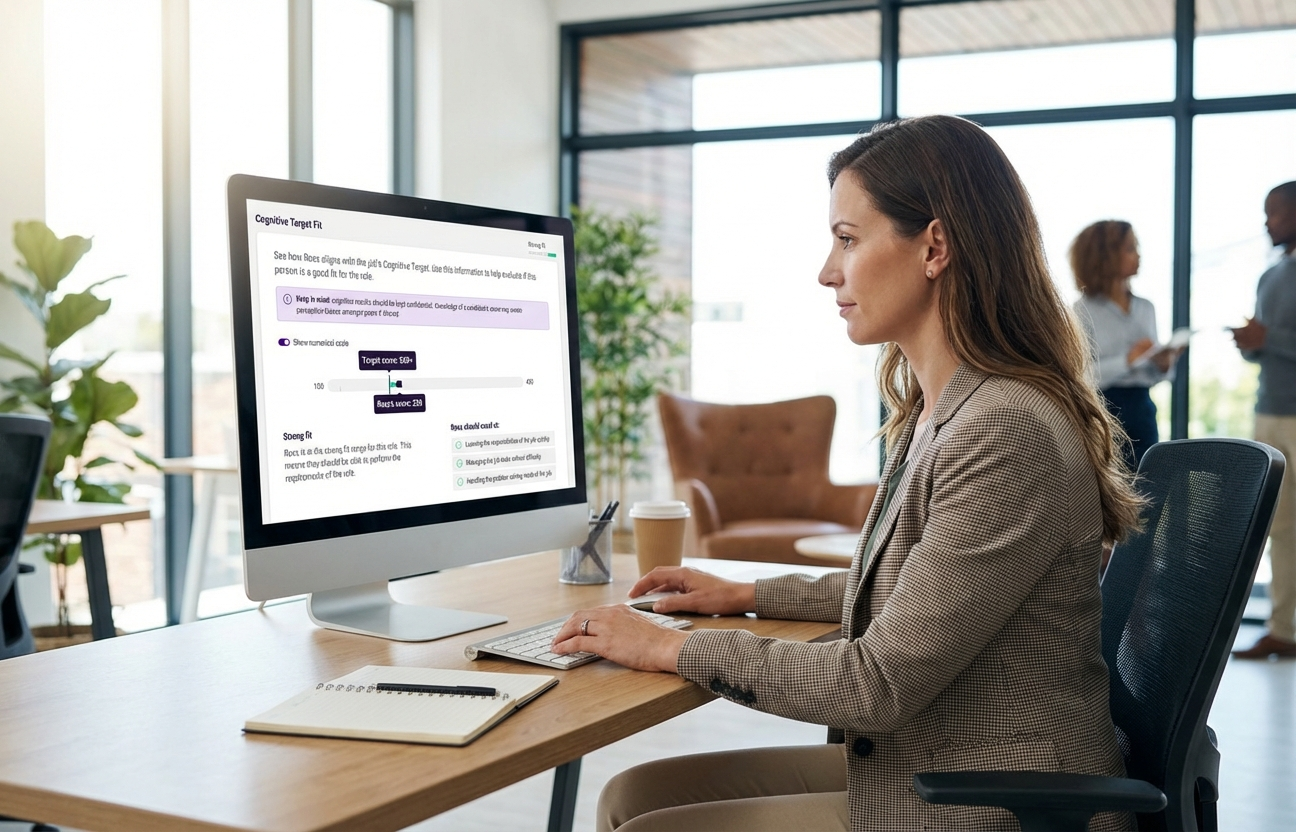
The output is a score that can be interpreted relative to role benchmarks and the broader distribution of results. The key is not "high is always better," but rather:
- What level of cognitive demand does the role require?
- What benchmark aligns with successful performance in that role?
- How do results align with other evidence (interviews, experience, behavioral data)?
5) Best Use Cases: When PI Cognitive Adds the Most Value
PI Cognitive tends to deliver the strongest ROI in roles where adaptability and rapid learning are success-critical.
Sales Roles
Consultative selling, complex products, and changing buyer requirements
Operations/Project Roles
Coordination, prioritization, and cross-functional problem-solving
Finance/Analytics/Strategy
Reasoning and structured thinking dominate
Management Roles
Decisions involve tradeoffs, ambiguity, and complex systems
Technical Roles
Problem-solving and learning speed matter even more than current tools
In contrast, in highly routine roles with stable procedures and low cognitive load, PI Cognitive may be less predictive—or the benchmark threshold may be lower.
6) How to Use PI Cognitive Responsibly (And Avoid Common Mistakes)
Cognitive testing is powerful—but only when implemented responsibly.
Responsible Use Checklist
- Benchmark the role: Determine the cognitive demand needed for successful performance
- Use a structured process: Combine PI Cognitive with structured interviews, work samples (where relevant), and job criteria
- Avoid "one-score hiring": Do not make decisions based solely on PI Cognitive results
- Train hiring managers: Ensure they understand what the score means and how to use it within a decision rubric
- Use consistent standards: Apply the same process across candidates for the same role to improve fairness and defensibility
Common Mistakes to Avoid
- Treating PI Cognitive as a "general intelligence label" rather than a job-related signal
- Benchmarking too high because "we want the smartest people" (misaligned to actual role needs)
- Ignoring role context and using cognitive scores as a proxy for motivation or cultural fit
- Skipping structured interviews and relying on intuition plus a test score
7) PI Cognitive and Compliance Considerations
Any pre-employment assessment should be used with care. Organizations should ensure their selection process is:
- Job-relevant
- Consistently applied
- Aligned with internal policies and jurisdiction-specific rules
Because compliance requirements vary by country, state, and industry, organizations should consult qualified counsel or HR compliance professionals to confirm appropriate use.
8) PI Cognitive vs. Behavioral Assessments: Why Both Matter
Organizations often confuse cognitive assessments with behavioral assessments. They answer different questions:
Cognitive Assessment
Can this person learn and solve problems at the pace and complexity required?
Behavioral Assessment
How does this person prefer to work, communicate, and engage with others?
High cognitive ability does not guarantee strong collaboration, leadership, or alignment with a specific working environment. Likewise, strong behavioral alignment does not guarantee the person can master complex tasks quickly.
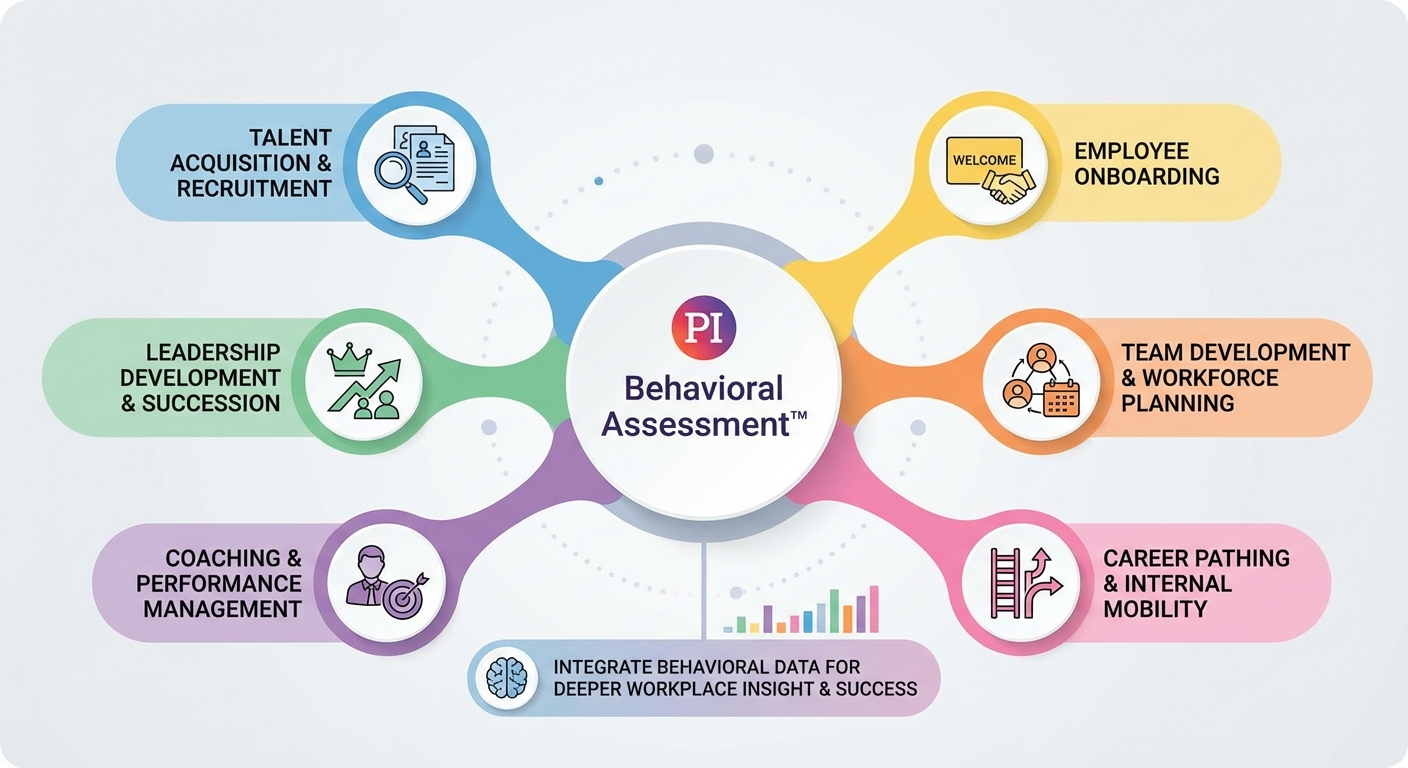
For best outcomes, combine both types of data within a structured selection and development framework.
9) FAQ: PI Cognitive Assessment™
Is PI Cognitive Assessment a personality test?
No. PI Cognitive is a cognitive ability assessment. It measures learning speed and reasoning—not personality traits or motivational drivers.
How long does PI Cognitive take?
Approximately 12 minutes.
Can PI Cognitive be used for internal promotions?
Yes, but it should be used thoughtfully and consistently. It can help estimate trainability for higher-complexity roles, especially when paired with performance data and behavioral insights.
Is a higher score always better?
Not necessarily. The goal is to match the role's cognitive demands. Over-benchmarking can screen out strong candidates who would perform well, while under-benchmarking can increase ramp time and performance risk.
Should PI Cognitive be used as the only hiring criterion?
No. Best practice is to combine PI Cognitive with structured interviews, job-relevant criteria, and (where appropriate) work samples or role simulations.
10) Practical Implementation: A Simple 4-Step Framework
If you want PI Cognitive to improve decision quality rather than create noise, implement it with a clear structure:
Define role success criteria
Clarify what top performers actually do, and what "good" looks like in the first 90–180 days.
Benchmark the role
Identify cognitive demand and establish a benchmark aligned to successful incumbents and role complexity.
Build a decision rubric
Combine PI Cognitive results with structured interview scoring and other job-relevant evidence.
Train and operationalize
Integrate PI Cognitive into structured interviews and decision rubrics. Train HR teams and hiring managers on interpretation and responsible use. Align talent decisions with broader workforce strategy and change initiatives.
11) Conclusion and Next Steps
If your roles require rapid learning, analytical rigor, or frequent problem-solving, PI Cognitive Assessment™ can provide a defensible, objective signal of trainability—helping you improve quality of hire and accelerate time-to-productivity.
Ready to reduce hiring risk and build a more adaptable workforce?
- Request a role benchmark review to determine whether PI Cognitive should be used for your key positions.
- Get an implementation roadmap that combines PI Cognitive, structured interviews, and behavioral insights.
- Train your hiring managers so assessment data improves decisions—not confusion.
The PI Cognitive Assessment™ is used as part of PI Hire—our structured selection workflow that helps you match candidates to role requirements and make more consistent, defensible hiring decisions.

Founder & Principal Consultant
MSc in I/O Psychology, 13+ years in leadership roles with A.P. Moller Group, now advising global organizations on talent strategy.
Progressica is a global provider of scientifically validated cognitive and behavioral assessments, helping organizations worldwide make smarter hiring and talent decisions. As a licensed partner of The Predictive Index®—a leader in talent optimization—we support clients across Malta, Italy, the Netherlands, Germany, Belgium, the Baltics, Saudi Arabia, the UAE, Singapore, Indonesia, Malaysia, Pakistan, and beyond. Our solutions span recruitment, leadership development, and strategic workforce planning.
Disclosure: PI Cognitive Assessment™ is a product of The Predictive Index. This article is educational and should not be treated as legal advice; consult counsel for jurisdiction-specific compliance.