Contents
In Brief
PI Hire transforms traditional hiring by overlaying a data-driven backbone across your entire recruitment process. Starting with a Job Target workshop to define behavioral and cognitive requirements, the workflow guides you through optimized job advertising, assessment-informed screening, structured interviews using PI Interview Guides, and finally data-supported onboarding. The result is more consistent hiring decisions, reduced time-to-productivity, and better long-term retention.
Key Takeaways
- Start every hire with a Job Target workshop—align stakeholders on behavioral and cognitive requirements before posting the role.
- Use the Job Ad Optimizer to attract candidates whose motivations match your target profile.
- Screen candidates using PI fit scores alongside traditional resume review to surface hidden gems and reduce mismatches.
- Run structured interviews with PI Interview Guides tailored to each candidate's specific gaps and strengths.
- Extend PI data into onboarding—managers can tailor early support based on the new hire's behavioral profile.
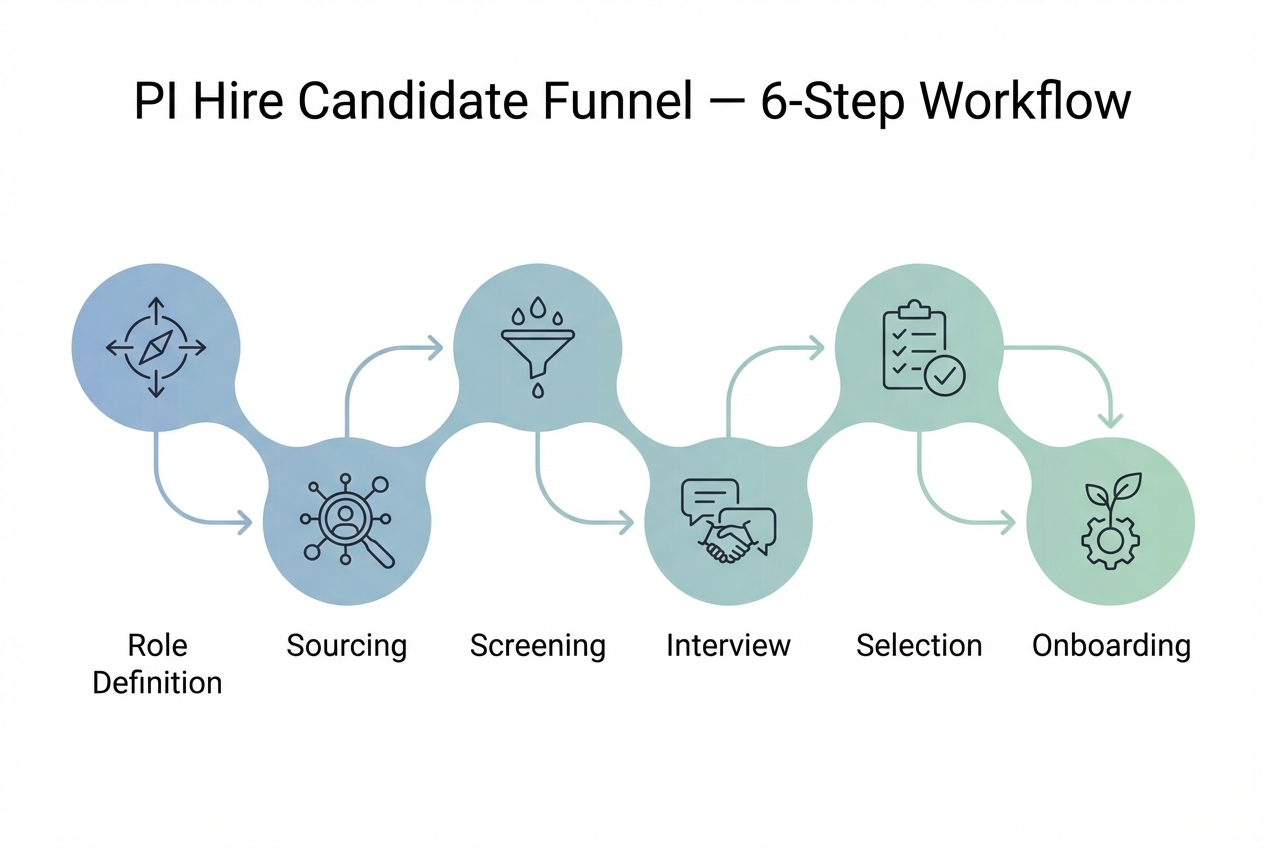
Let's get practical. How do you actually use PI Hire step-by-step in a hiring process? We've touched on the components; now we'll string them together in a typical workflow. Whether you're a hiring manager or a recruiter, think of this as the new blueprint for filling a position—one that leverages behavioral and cognitive assessments alongside role design.
Role Definition & Job Target Creation
Every great hire starts with a clear understanding of the role. Begin by gathering key stakeholders – usually the hiring manager (the person the new hire will report to), someone from the team or a top performer in a similar role, and HR or a recruiter.
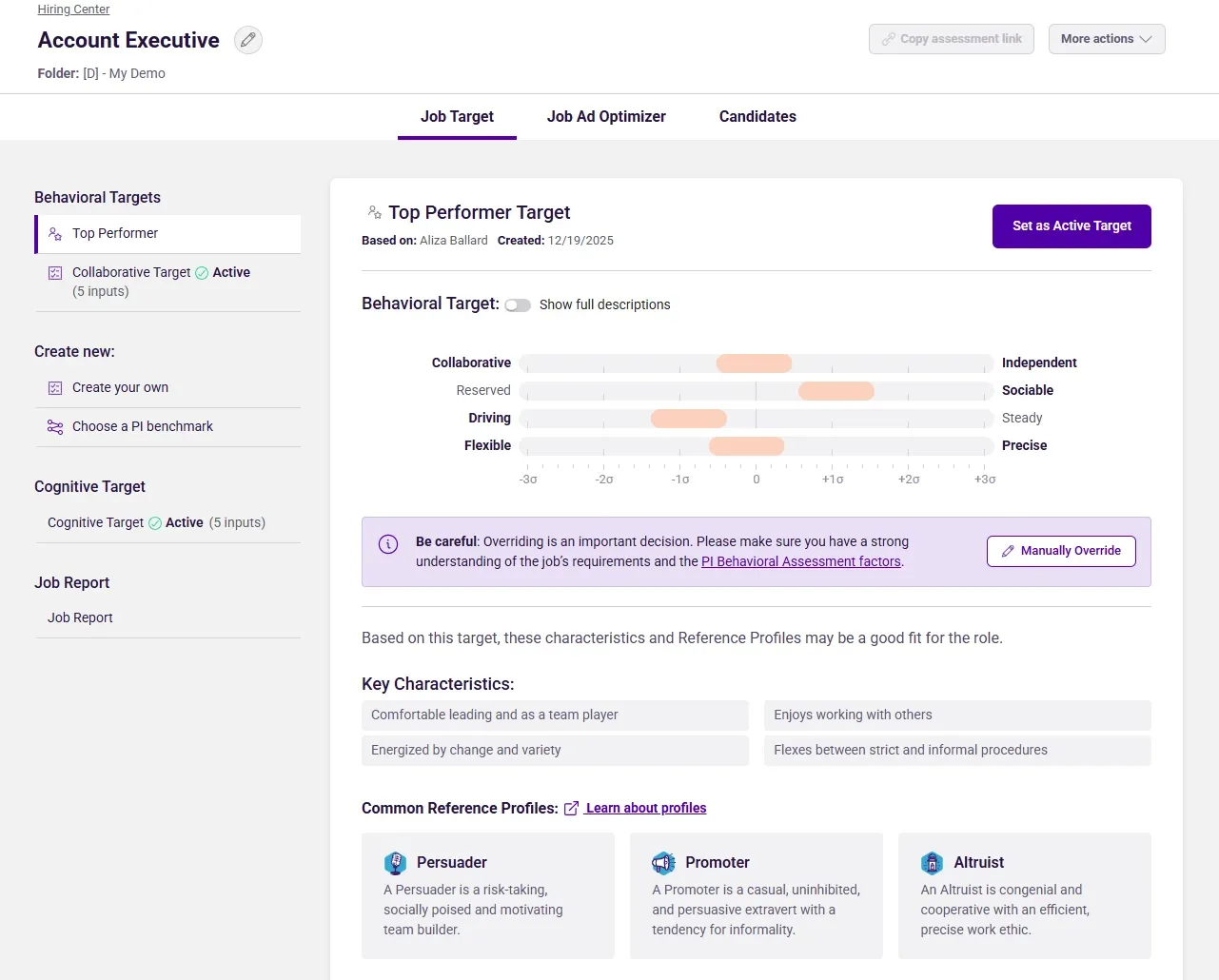
Using PI Hire, conduct a Job Target workshop (this can be a meeting or done asynchronously via the PI software). In this step, you collectively answer: "What does the ideal candidate look like for this job, behaviorally and cognitively?" The PI platform might have each stakeholder take a short survey about the role's needs, then it combines the input into a proposed Job Target profile. Stakeholders review it, discuss any differences, and finalize the target.
For example, say you're hiring a Customer Support Representative. Stakeholders agree the person needs high patience (because support can be repetitive and requires calm), moderately high extraversion (friendly and helpful, but not necessarily the life of the party), lower dominance (since the role is about following protocols and being accommodating), and a certain baseline of cognitive ability to navigate multiple systems and product knowledge quickly. That becomes your Job Target for Customer Support Rep. Now, everyone agrees that's what you're looking for – so when résumés come in, you're not just intuitively scanning for customer service buzzwords; you know the underlying traits that matter.
Note: Progressica, as a PI Certified Partner, often facilitates these job targeting sessions for clients initially, to ensure accuracy and agreement. If you're new to it, that guidance can be very useful.
Additionally, you use the Job Ad Optimizer in PI Hire to refine your job posting. Perhaps it suggests adding phrases that appeal to your target's motivations. For instance, for that Customer Support role, the optimizer might encourage language about "stability" and "helping customers with patience" – aligning the ad with the profile so that people who read it self-select (either "Yes, that's me" or "No, that doesn't sound like me," which is actually helpful).
Sourcing and Advertising
With the optimized job description, you advertise the role through your usual channels (job boards, LinkedIn, your careers page, etc.). Because the ad is tuned to attract the right behavioral profile (as well as the right skills), you might already start to see a better applicant pool.
In the application, you can integrate a PI Behavioral Assessment invite – many companies choose to have candidates take the assessment as part of submitting their application (or immediately after). This is straightforward: PI Hire can generate a unique assessment link for the job, which you include in your application process communications.
Some companies prefer to wait until after an initial résumé screen to send assessments, which is fine too. But doing it early has advantages: you get data on all applicants, not just the ones you think look good on paper. Sometimes a candidate with an unconventional background might score brilliantly on the assessments, causing you to give them a chance where you otherwise might not have. Conversely, a golden résumé might mask a poor fit that the assessments reveal.
Initial Screening with Data
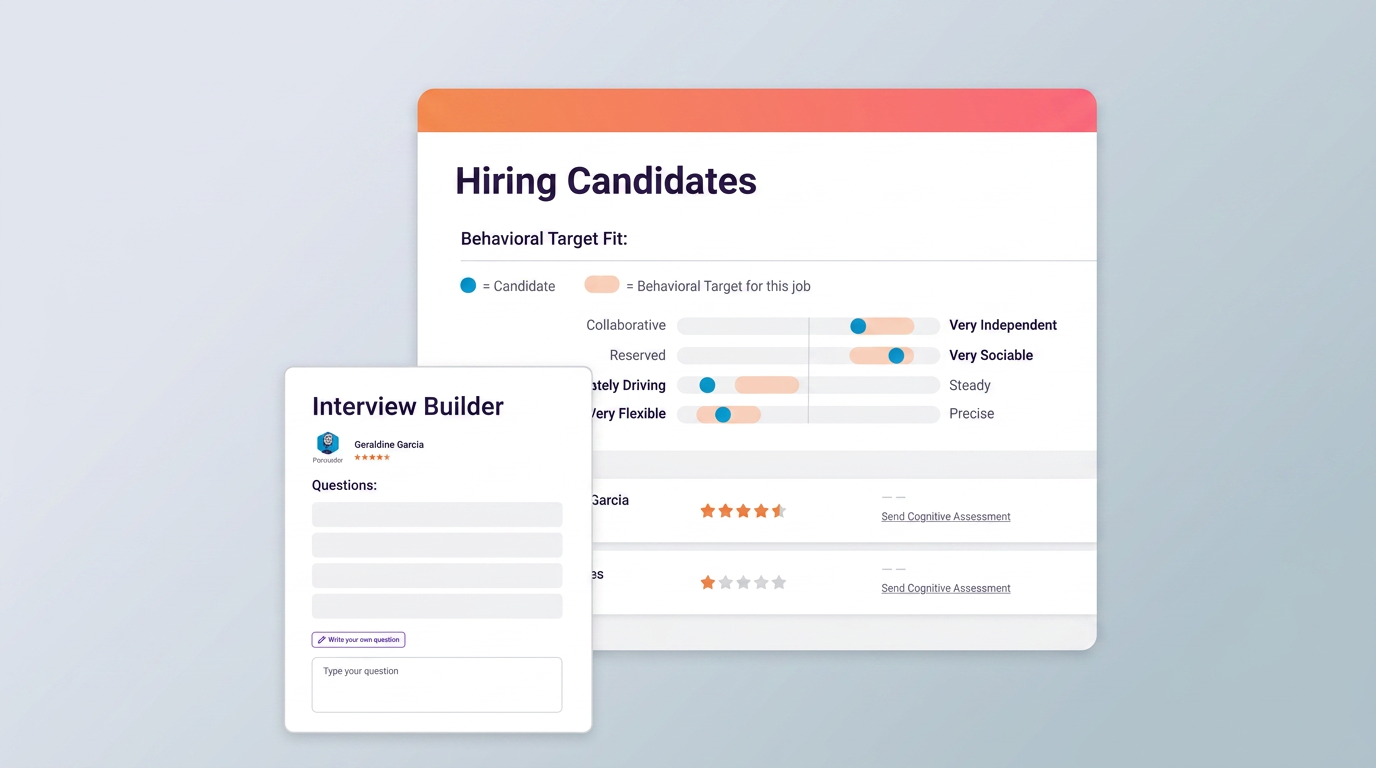
As applications roll in, you (or the recruiter) conduct an initial screen. This might involve a quick scan of résumés for must-have qualifications, but alongside that, you check the PI Hire dashboard to see each candidate's fit score relative to your Job Target.
Let's say 50 people applied and 30 have completed the PI assessments so far. You see that 5 of them have a match score of 8 or above – great! Those immediately catch your eye, because PI Hire is telling you they align well with your ideal profile. Perhaps another 10 are in the moderate range (5–7), and the rest are lower.
At this stage, you might do a quick phone screen or video screen with the top group. Because you already have insight into their behavioral and cognitive fit, your phone screen can be more targeted. For example, if someone's a high fit, the phone screen is mostly to verify their experience and communication skills, etc., since their intrinsic traits seem on point. If someone is a moderate fit (maybe one key trait off), you might use the phone screen to specifically probe that. PI Hire even offers suggestions for phone screen questions based on fit, or you can use the interview guide in a lightweight way here.
You'll also pay attention to any obvious mismatches. For instance, if someone scored very low on something non-negotiable (like the cognitive score is way under the target for a role that needs quick learning), you might decide not to move them forward at all, saving time for both parties.
Shortlist and Interview
Based on the initial screens and PI data, you decide who to invite for formal interviews. Let's imagine you narrow it down to 5 finalists. Now you fully leverage the PI Hire Interview Guides for each of these 5 candidates.
Before the interviews, you share each candidate's PI results and interview guide with the interviewing team (e.g., the hiring manager and two team members). This is done through PI Hire's portal – or you can export it to a PDF, etc. Each interviewer can be assigned specific areas to focus on, or you might all cover a breadth of topics but from different angles.
During the interviews, you ask the structured questions provided. For example, every candidate gets questions A, B, C (core to the role). Then Candidate-specific QX for candidate X, QY for candidate Y, etc., which address their unique profile gaps/strengths. Interviewers take notes and possibly score answers as they go.
Example: The job target values "high attention to detail". Candidate John's behavioral assessment suggests he's medium on detail, not naturally as high as the target. The interview guide for John includes:
"Describe a time you made a mistake due to an oversight. What did you learn from it and what changes did you implement to ensure accuracy going forward?"
John provides an answer – the interviewers note that he did have a good system for double-checking his work after that mistake, indicating he's aware of his tendency and manages it. That's a positive sign; it mitigates the concern raised by the assessment.
After interviews, your hiring team convenes. Now you have multiple data points on each of the 5 finalists:
- •Résumé/experience info
- •PI Behavioral & Cognitive results
- •Match Score and trait-by-trait alignment info
- •Structured interview responses (ideally with some ratings or at least qualitative notes on each question)
This is a much richer picture than the old "I liked him; did you like him?" conversation. You might even use PI Hire's tools to compare candidates side by side. For instance, the platform might show a side-by-side of two finalists' behavioral profiles against the target, highlighting where each has edges.
The beauty of data is you can have these nuanced conversations. You're not guessing; you're interpreting real data. It transforms hiring meetings from subjective debates to more like an analytic review. It's common to hear things like, "Candidate A scored a 9 on fit and handled all the behavioral interview questions excellently – seems like a slam dunk. Candidate B scored a 7 on fit; he's a bit outside the target on XYZ, and we noticed that in his answers. Maybe not the best choice unless we think his technical skills vastly outweigh those differences."
Selection and Offer
With all information considered, you make your choice. Let's say Candidate A emerges as the frontrunner. You proceed with reference checks (if you do them) – even here, PI Hire's insights can guide you on what to ask references ("She'll need to multitask a lot in this role; have you seen her excel in that kind of environment?"). When all checks out, you extend the offer.
Because you've been data-driven, you can even justify the hire to higher-ups or stakeholders with ease: "We chose A because, in addition to her experience, her PI behavioral profile closely matched our top performer's profile, her cognitive score indicates she'll pick up training quickly, and she demonstrated in structured interviews that she has both the customer-focus and the attention to detail we need. The data predicts she'll likely excel and stay long-term."
Onboarding and Beyond
The story doesn't end at hiring – one cool side effect of using PI Hire is that you now have valuable data on your new hire that can be used for onboarding and management.
Many companies share the new employee's PI Behavioral results with their direct manager and team. For instance, if the person's profile shows they prefer detailed instructions and feedback, the manager knows to be a bit more hands-on initially. Or if the profile shows they're a big social extravert, the manager ensures they integrate with the team and perhaps assigns a buddy.
The result? The new hire gets up to speed faster and feels understood. PI even has complementary tools (PI Inspire, PI Team Discovery, etc.) to use the behavioral data for team dynamics. So the benefit of that initial hiring data extends into engagement and retention, truly completing the talent lifecycle.
Summary: A Data-Driven Backbone for Hiring
As you repeat this PI Hire workflow for various roles, you're also gathering aggregate data. Over time, you can analyse things like: which Job Targets are easiest or hardest to fill? Are there patterns in who succeeds that we should refine our targets for? Perhaps you notice that all hires who had at least an 8 in match score and a certain cognitive range ended up being high performers at 1 year. That reinforces your future decisions and might even adjust your thresholds.
Integration with existing systems:
It's worth noting that PI Hire can integrate with many Applicant Tracking Systems (ATS). That means the assessment links and scores can be pulled into the ATS, creating a seamless experience for recruiters. It's not a standalone island; it plays nicely with your current recruiting workflows, just making them smarter.
In summary, integrating PI Hire essentially overlays a data-driven backbone to your hiring process. You still do the human parts – crafting the job description, talking to candidates, selling the role – but you do them informed by data at every critical juncture. The result is a workflow that's more efficient, more consistent, and yields better hires than the old way. It might feel like more front-loaded work initially (setting up assessments, etc.), but it pays off massively in saved time down the line and in the quality of the person you bring on board.
Written by

Founder & Principal Consultant
MSc in I/O Psychology, 13+ years in leadership roles with A.P. Moller Group, now advising global organizations on talent strategy.
Progressica is a global talent assessment provider delivering scientifically validated talent assessments and hiring assessments to organizations worldwide. As the licensed partner of The Predictive Index®, a global leader in talent optimization, Progressica enables businesses to make data-driven hiring decisions, improve workforce performance, and align people strategy with business goals. We provide talent assessment solutions to clients across Malta, Italy, the Netherlands, Germany, Belgium, Latvia, Lithuania, Estonia, Saudi Arabia, the UAE, Singapore, Indonesia, Malaysia, Pakistan, and other international markets, supporting effective recruitment, leadership development, and long-term talent optimization.