Contents
In Brief
Role design with The Predictive Index goes beyond traditional job descriptions by defining the behavioral and cognitive requirements for success in each role. Using the PI Job Assessment, organizations create a Job Target that becomes the shared standard for hiring, onboarding, coaching, and team planning—turning role clarity into an execution lever that scales across the entire talent lifecycle.
Key Takeaways
- Traditional role design fails because it describes tasks instead of success requirements—leading to mis-hires, slow onboarding, and inconsistent management
- The PI Job Assessment creates a Job Target that defines behavioral and cognitive fit for each role
- A 5-step workflow covers stakeholder alignment, Job Target creation, hiring integration, onboarding calibration, and ongoing governance
- Role design with PI extends beyond hiring into coaching, team planning, and succession management
- Governance and regular review of Job Targets ensures roles evolve with business strategy
Quick Answer
Role design with The Predictive Index (PI) uses the PI Job Assessment to create a Job Target that defines the behavioral and/or cognitive requirements for success—then applies that target to hiring, interviewing, onboarding, coaching, and team planning.
Why Role Design Fails in Fast-Growing Organizations
Most role design breaks down for one reason: the role is described by tasks instead of success requirements. This is why data-driven hiring starts with defining what good looks like before sourcing candidates.
That creates predictable failure modes:
At C-suite level, this shows up as missed targets, uneven execution, and leadership bandwidth consumed by preventable people issues.
What "Role Design" Actually Means (And Where PI Fits)
Role design is the discipline of defining:
Outcomes
The role must deliver (90/180/365 days)
Context
The role operates in (pace, ambiguity, stakeholders, decision rights)
Success Requirements
Including the behavioral and, where relevant, cognitive demands
PI supports (3) by translating the role into an actionable target.
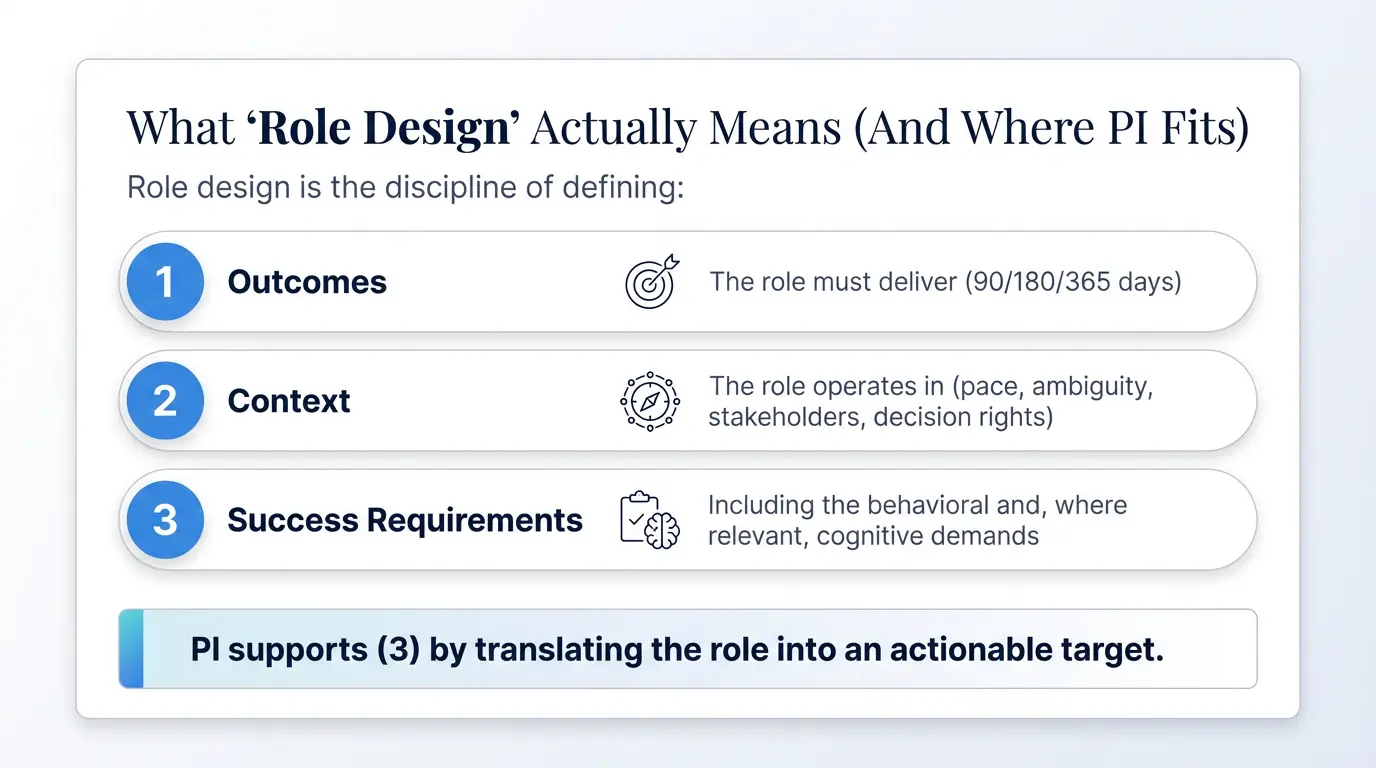
Define outcomes, calibrate requirements, then operationalise the target.
The Executive-Ready Method: A 5-Step PI Workflow
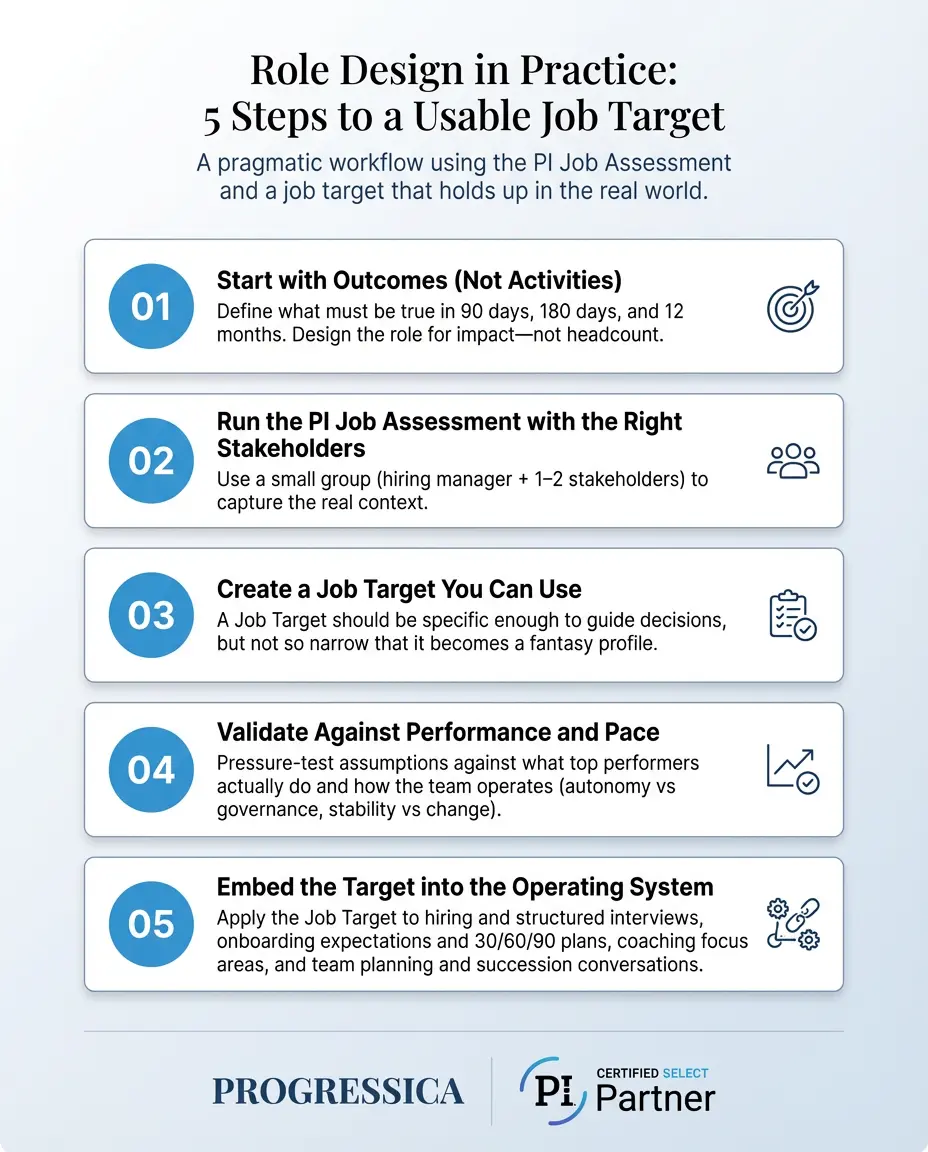
A lightweight workflow leaders actually adopt.
Start with Outcomes (Not Activities)
Define what must be true in 90 days, 180 days, and 12 months. Design the role for impact—not headcount.
Run the PI Job Assessment with the Right Stakeholders
Use a small group (hiring manager + 1–2 stakeholders) to capture the real context.
Create a Job Target You Can Use
A Job Target should be specific enough to guide decisions, but not so narrow that it becomes a fantasy profile.
Validate Against Performance and Pace
Pressure-test assumptions against what top performers actually do and how the team operates (autonomy vs governance, stability vs change).
Embed the Target into the Operating System
Apply the Job Target to hiring and structured interviews, onboarding expectations and 30/60/90 plans, coaching focus areas, and team planning and succession conversations.
Use PI Role Design Across the Talent Lifecycle
A Job Target doesn't stop at hiring. When embedded properly, it becomes the backbone for:
Hiring
Use match scores and Interview Guides for structured, consistent decisions
Onboarding
Set expectations based on behavioral fit from day one
Coaching
Focus development on gaps between profile and target
Team Planning
Surface behavioral gaps in team composition and succession
Governance: Keeping Role Design Alive
Without governance, Job Targets become outdated documents. Establish:
KPIs: Measuring Role Design Impact
Track these metrics to quantify the value of better role design:
Frequently Asked Questions
Key Takeaway
Role design with The Predictive Index turns vague job descriptions into actionable success requirements. By running a PI Job Assessment and creating a Job Target, you give hiring managers, coaches, and team leaders a shared language for what success looks like—and the tools to achieve it.
The result: better hires, faster ramp, clearer expectations, and lower regrettable attrition.
Written by

Founder & Principal Consultant
MSc in I/O Psychology, 13+ years in leadership roles with A.P. Moller Group, now advising global organizations on talent strategy.
Progressica is a global talent assessment provider delivering scientifically validated talent assessments and hiring assessments to organizations worldwide. As the licensed partner of The Predictive Index®, a global leader in talent optimization, Progressica enables businesses to make data-driven hiring decisions, improve workforce performance, and align people strategy with business goals. We provide talent assessment solutions to clients across Malta, Italy, the Netherlands, Germany, Belgium, Latvia, Lithuania, Estonia, Saudi Arabia, the UAE, Singapore, Indonesia, Malaysia, Pakistan, and other international markets, supporting effective recruitment, leadership development, and long-term talent optimization.