Contents
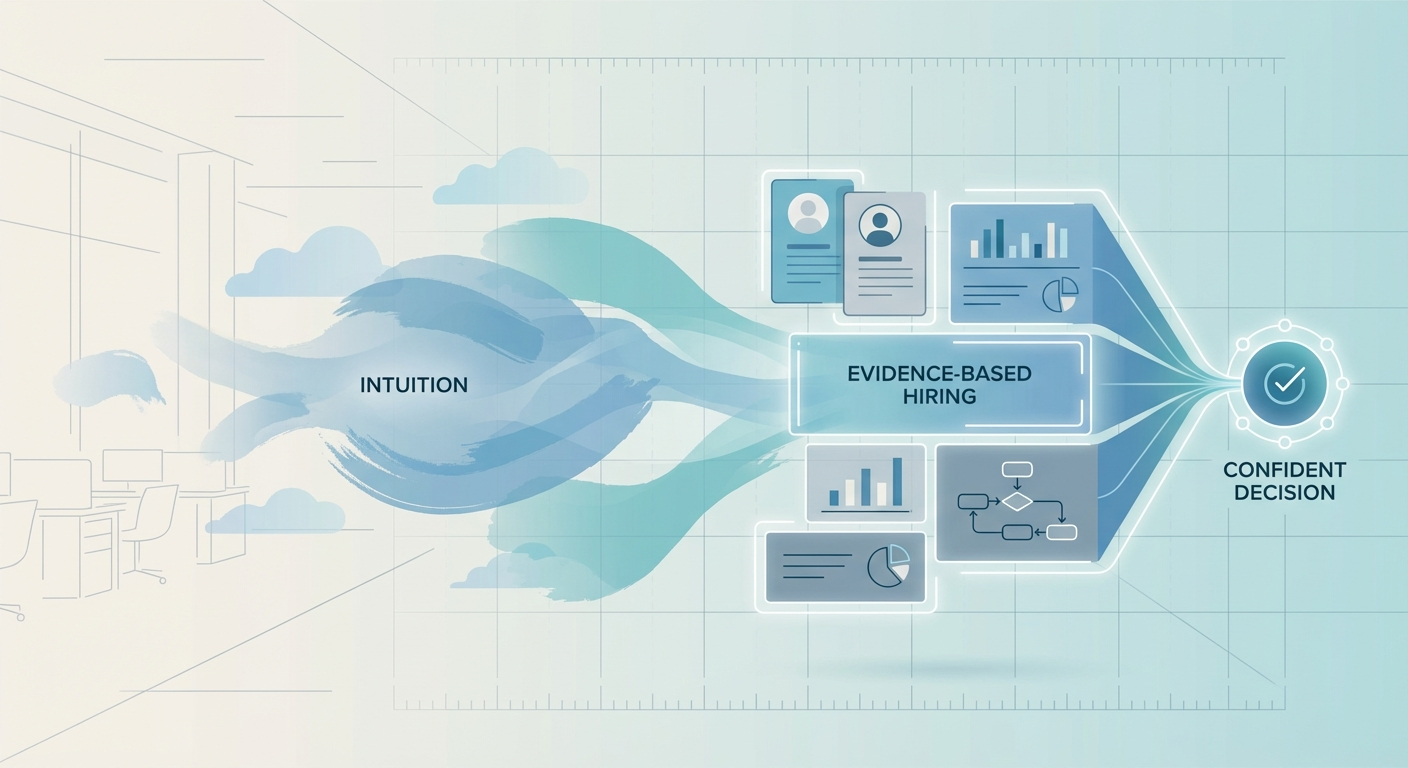
Hiring is a prediction problem, but most organizations still hire as if it is a debate. When the role is not clearly defined beyond a job description, interview panels end up assessing different versions of success, and decisions default to gut feel, proxies such as years of experience or brand-name employers, or whoever argues best in the debrief.
That misalignment is expensive. It slows hiring cycles, increases the risk of a costly mis-hire, and creates inconsistency that is hard to defend, especially when stakes are highest in leadership roles, revenue-impact positions, and critical specialists.
A Predictive Index Job Assessment solves the definition problem first. By creating a clear Job Target—the behavioral and/or cognitive requirements needed to succeed—you give every stakeholder a shared standard for fit. With PI Hire, you can operationalise that target into a repeatable workflow that supports aligned evaluation, structured interviews, and faster, more confident decisions.
In Brief
The Predictive Index Job Assessment is a structured process for defining what a role truly requires before hiring begins. By creating a Job Target—a shared benchmark for behavioral and cognitive fit—organizations align stakeholders, reduce bias, and move from subjective debate to evidence-informed selection. When operationalised through PI Hire, the Job Target becomes the anchor for candidate evaluation, structured interviews, and repeatable hiring decisions across teams and locations.
Key Takeaways
- Job descriptions list responsibilities; Job Targets define the behavioral and cognitive demands needed to succeed
- Misalignment between interviewers is the top cause of inconsistent hiring decisions and costly mis-hires
- A PI Job Assessment creates a shared standard for fit before CV screening or interviews begin
- PI Hire operationalises the Job Target into a repeatable workflow with structured interviews and candidate alignment scores
- The assessment defines the role, not the person—it supports judgment rather than replacing it
- Organizations see the greatest impact in leadership roles, revenue-critical positions, and specialist hires
Why Job Descriptions Aren't Enough
A job description is a list of responsibilities. But hiring is a prediction problem: you're trying to predict performance, learning speed, and how someone will show up under pressure, ambiguity, or change.
When a role isn't clearly defined beyond tasks, three failure modes appear:
The Panel Problem
Hiring managers, HR, and stakeholders interview for different versions of the role—often unconsciously.
The Resume Proxy Trap
Credentials get used as a substitute for capability or fit when the team can't articulate what matters most.
The Interview Signal Problem
Without a target, interview questions drift toward hypotheticals and 'likeability,' making the process inconsistent.
The Real Cost of Misalignment
Mis-hires aren't just recruiting issues; they're strategy issues. When the wrong person lands in a critical role, the costs compound:
- Execution risk: the role under-delivers, priorities slip, and leaders spend time compensating.
- Team drag: high performers get frustrated when role expectations are unclear or performance is inconsistent.
- Re-hiring tax: you re-open a requisition months later—after lost momentum, not before.
- Bias risk: inconsistent processes increase the likelihood of subjective decisions (and the debate that follows).
This is why mature HR functions shift from selection by opinion to selection by shared criteria—a principle at the heart of data-driven hiring—without pretending any assessment should make the final call.
Definition and Purpose
Quick answer: A Predictive Index Job Assessment is a structured way to define a role's success requirements by creating a Job Target. That target aligns stakeholders on the behavioral and cognitive demands of the job, and tools like PI Hire use it to guide candidate evaluation and structured interviewing.
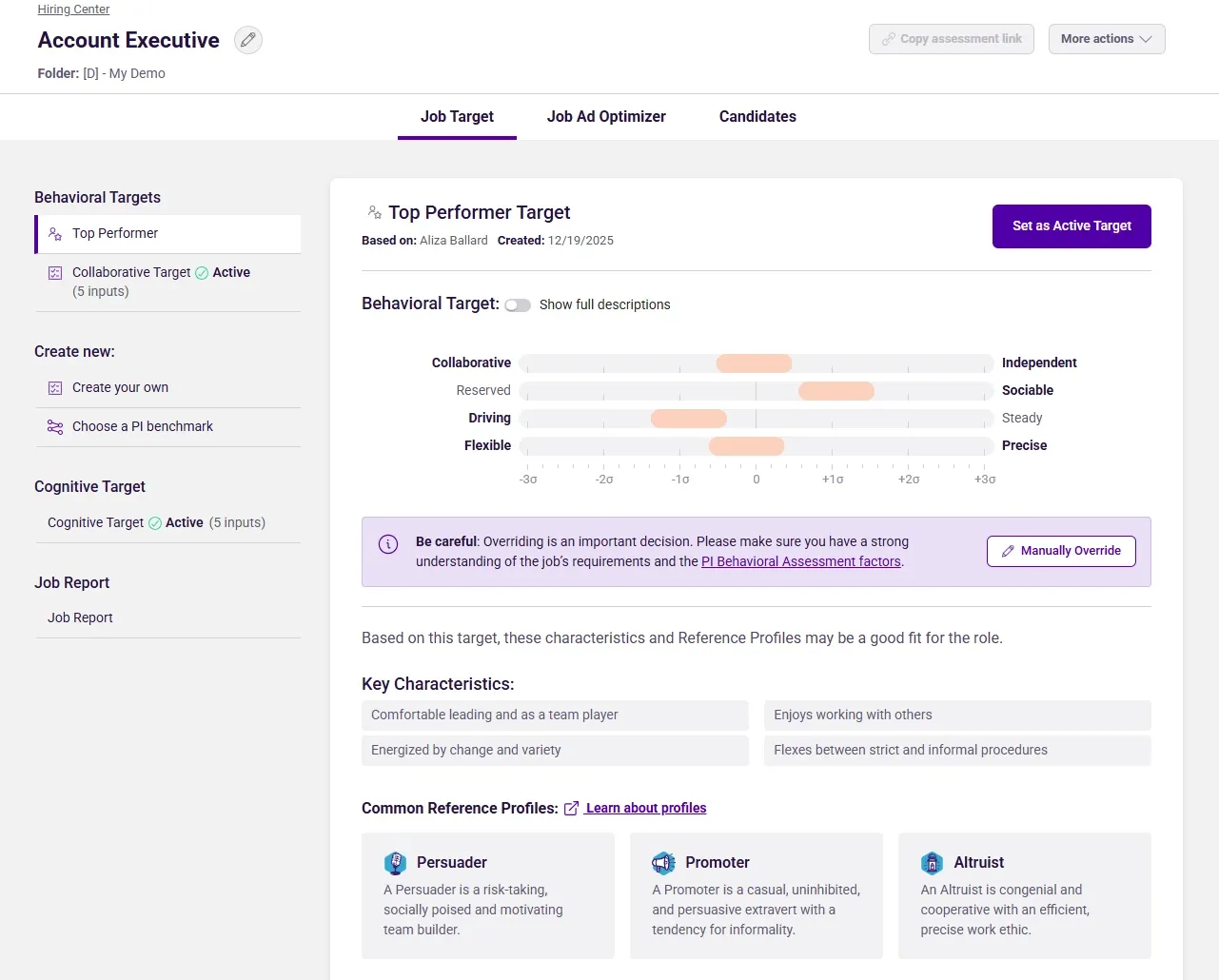
The PI Job Assessment is used to define role requirements before hiring. According to PI, stakeholders (often hiring managers, supervisors, or HR partners) answer a short series of behavioral questions about a role. The output is a Job Target capturing the ideal behavioral profile (and cognitive level if used). PI's documentation stresses this process allows hiring teams to clarify needs "upon entry" to avoid ambiguity. By setting concrete target traits, interviews and hiring decisions can be based on agreed criteria.
Notably, this assessment is about the role, not the person. PI explicitly states it "does not measure characteristics of a person." In other words, it's not a candidate test, but a job-side tool. This distinction should be made clear to candidates and stakeholders. It avoids privacy issues of profiling individuals at this stage and focuses on aligning internal expectations.
Quick Facts
Conducted by
Role stakeholders (individual or team). PI allows inviting stakeholders via email; no PI software login is needed.
Format
20 behavioral items (5 per factor) in the current short form. Originally PI used 90 items; internal analysis showed 20-item results are comparable.
Output
A Job Target (ideal ranges on PI's behavioral factors A–D; plus an optional cognitive range). PI generates a Job Report summarising this target along with the job description and preferred traits.
Purpose
To provide an objective benchmark for evaluating candidates via PI's Fit Rating. It's intended to reduce bias by focusing on predetermined requirements.
Administration Workflow
Create the Job in PI Hire
This sets up a new position in the platform.
Invite stakeholders to the Job Assessment
Typically 3–5 key contributors are invited via email. Stakeholders receive a link to the survey; no PI account login is required.
Collect inputs
Stakeholders each answer the behavioral questions (and a cognitive screening question if used). PI automatically aggregates responses.
Generate Job Target
PI presents a Job Target based on inputs. At this stage, the team reviews the target. The system enforces target ranges not wider than one standard deviation, to avoid overly broad targets.
Refine if needed
Stakeholders can adjust the target if it seems misaligned. PI's guidance emphasises alignment among stakeholders, warning that too wide or too narrow targets weaken the process.
Publish Job Report
The final Job Target and job profile can be shared with the hiring panel. PI's Job Report includes the role description, preferred behaviors, and the final target ranges.
Proceed to candidate assessment
Assign candidates to this job in PI. Send candidates PI's Behavioral (and Cognitive, if applicable) assessments.
Where PI Hire Fits In
If the PI Job Assessment is the definition engine, PI Hire is the workflow that operationalises it—so hiring becomes repeatable, structured, and easier to govern. For a deeper walkthrough, see the PI Hire guide.
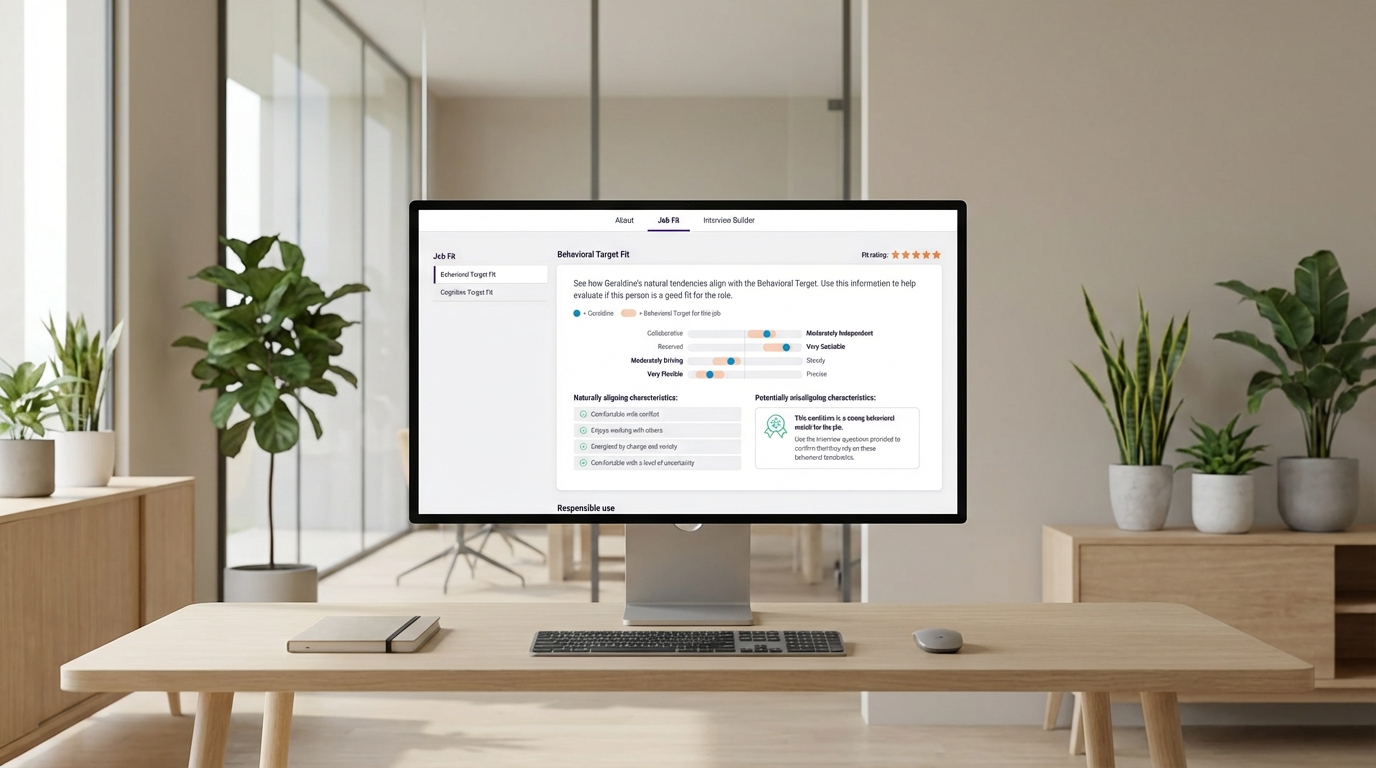
Candidate-to-target alignment
Comparing candidate insights to your Job Target to highlight strengths and potential risk areas.
Structured interviews
Building interview questions that target the traits and demands of the role (instead of generic questions).
Consistency at scale
Making hiring less dependent on individual manager style and more dependent on a shared standard.
PI Job Assessment defines what "fit" means for the role. PI Hire helps you apply that definition consistently across candidates.
End-to-End: From Hiring Need to Decision
Click each step as you complete it to track your progress.
Scoring and Interpretation
Fit Rating (Current Standard)
In PI's current system, Fit Rating is the metric showing how well a candidate matches the Job Target. According to PI support:
- Behavioral Fit is scored on a 1–5 scale (5 stars is strongest fit).
- Cognitive Fit is displayed as Strong / Moderate / Cautionary based on whether the candidate's cognitive result is above, near, or below the job's cognitive target.
Official stance: PI repeatedly emphasises that Fit Rating is an indicator and "does not make hiring decisions." It is a tool to focus a search, not an automated filter.
Legacy Match Score
Before Fit Rating was introduced, PI's system showed a Match Score from 1–10. PI explains that "Match Score is now Fit Rating"; in the new interface they use stars with half-star increments, effectively keeping the 10-point granularity. The underlying idea is the same: a higher Match Score / Fit Rating means the candidate's behaviors (and cognitive) better align with the Job Target.
| Indicator | Scale | Purpose | Official Note |
|---|---|---|---|
| Fit Rating (current) | 1–5 stars (half-stars) | Indicates candidate-to-job fit. Organising tool for recruiters | "Does not make hiring decisions," final verdict requires human review |
| Match Score (legacy) | 1–10 numeric | Same intent, older interface. Used in older PI apps | Renamed to Fit Rating in current experience |
PI does not publish an exact equation for computing these scores (this would be proprietary). Thus, any claims about precise calculation steps or thresholds are not publicly verifiable.
Interpretation Note
For decision-makers, the key takeaway is that Fit Rating is a summarised measure of alignment. A higher Fit Rating suggests candidate results are closer to the target. However, both PI guidance and legal best practice mandate that this number be used as one input among many. Good practice includes structured interviewing and holistic evaluation, not just filtering by Fit Rating.
What Strategic HR and the C-Suite Get Out of It
Faster alignment
A Job Target creates a single definition of fit that hiring teams can align around—reducing 'post-interview politics.'
More defensible decisions
When your process is anchored to role requirements (not just opinions), decisions become easier to explain and improve.
Better interviews
Structured, role-relevant questions raise interview quality—especially when hiring managers vary in experience.
A repeatable hiring system
Once you can define roles, align stakeholders, and structure interviews consistently, hiring becomes a system you can measure, refine, and scale.
Use Cases and Limitations
Typical Use Cases
Officially, PI positions the Job Assessment as useful for:
Defining roles for new hires
Especially in teams unfamiliar with formal competence frameworks.
Calibrating existing roles
For succession planning or performance development—to X-ray jobs and identify needed traits.
Aligning hiring panels
Ensuring everyone agrees on what traits are most important for the role.
Driving consistency
By documenting targets, PI aims to reduce bias and subjectivity in screening—a core principle of data-driven hiring.
In practice, companies often use it to create a job profile before posting a role, then compare candidate profiles to that target. Others use it to validate alignment after interviewing.
Limitations
Predictive Index materials warn of pitfalls:
Stakeholder Disagreement
If team inputs diverge, the resulting target may not reflect consensus. We suggest adjusting ranges to align with the help of a Talent Optimization Consultant (like a member of our team) or someone who has gone through a Predictive Index Workshop run by a Certified Partner.
Job Changes
Targets may need updating as roles evolve. We suggest periodic review if the role changes significantly—this may be 3, 6, 12, or 24 months depending on the organization.
Comparison with PI's Other Assessments
PI also offers Behavioral and Cognitive assessments for candidates. Brief distinctions:
| Assessment | Completed by | Format | Measures |
|---|---|---|---|
| PI Behavioral Assessment | Candidate | Free-choice adjective survey, ~6 min | Candidate drives and needs (behavioral profile) |
| PI Cognitive Assessment | Candidate | 50-question multiple-choice test, 12 min | General cognitive ability |
| PI Job Assessment | Stakeholders (not candidates) | 20 behavioral items per stakeholder | Role requirements → Job Target |
Key distinction: The Job Assessment (the focus of this article) is taken by stakeholders to set targets—not by candidates. The Behavioral and Cognitive assessments are then used to measure candidates against that target.
Common Misconceptions (and How to Avoid Misuse)
Misconception: "The assessment makes the decision"
Use it as decision support—clarify fit, identify risk areas, and improve interview quality—then validate through interviews and references.
Misconception: "We can copy a profile from another company"
Context matters. High-performing requirements are role- and environment-specific. Build targets for your role realities.
Misconception: "Our interviews are already good"
Even strong interviewers benefit from structure. The goal isn't more interviews—it's higher-quality signal.
Quick Self-Check: Are You Ready for PI Hire?
You'll usually see the clearest value if one or more of these is true:
- Hiring managers disagree on what 'good' looks like (especially for leadership, sales, or specialist roles).
- Interview quality varies by team or manager.
- You're scaling, restructuring, or building a leadership pipeline and want repeatable criteria.
- You want a process that's easier to govern and explain—internally and externally.
Key Takeaways
- A Job Target creates a shared definition of role fit—before interviews begin.
- The Predictive Index Job Assessment helps you define behavioral and/or cognitive requirements for a specific role.
- PI Hire operationalises that target through candidate alignment insights and structured interview planning.
- The goal isn't to replace judgment—it's to improve decision quality, consistency, and governance.
Frequently Asked Questions
What is a Predictive Index Job Assessment?
A PI Job Assessment helps your team define a role's requirements by creating a Job Target—so everyone hires against the same success criteria.
What is a Job Target in Predictive Index?
A Job Target is a benchmark for the behavioral and/or cognitive demands of a specific role, used to evaluate alignment and guide interviews.
Is the PI Job Assessment the same as assessing a candidate?
Not exactly. The Job Assessment defines the role target; candidate insights are compared against that target to inform selection.
How does PI Hire relate to the Job Assessment?
PI Hire uses the Job Target to structure hiring—supporting candidate alignment and interview planning tied to the target.
Does PI Hire replace interviews?
No. It improves interviews by focusing them on the role's required traits and likely caution areas.
When is this most useful?
When hiring teams disagree on fit, interview quality varies by manager, or you need consistent decisions at scale.
Written by

Marketing & Business Development Manager
Leads marketing and PI client success at Progressica, helping teams turn people data into practical decisions.
Progressica is a certified Predictive Index partner providing talent optimization services across Europe. We help organizations align people strategy with business strategy using validated behavioral and cognitive science. Learn more about us.